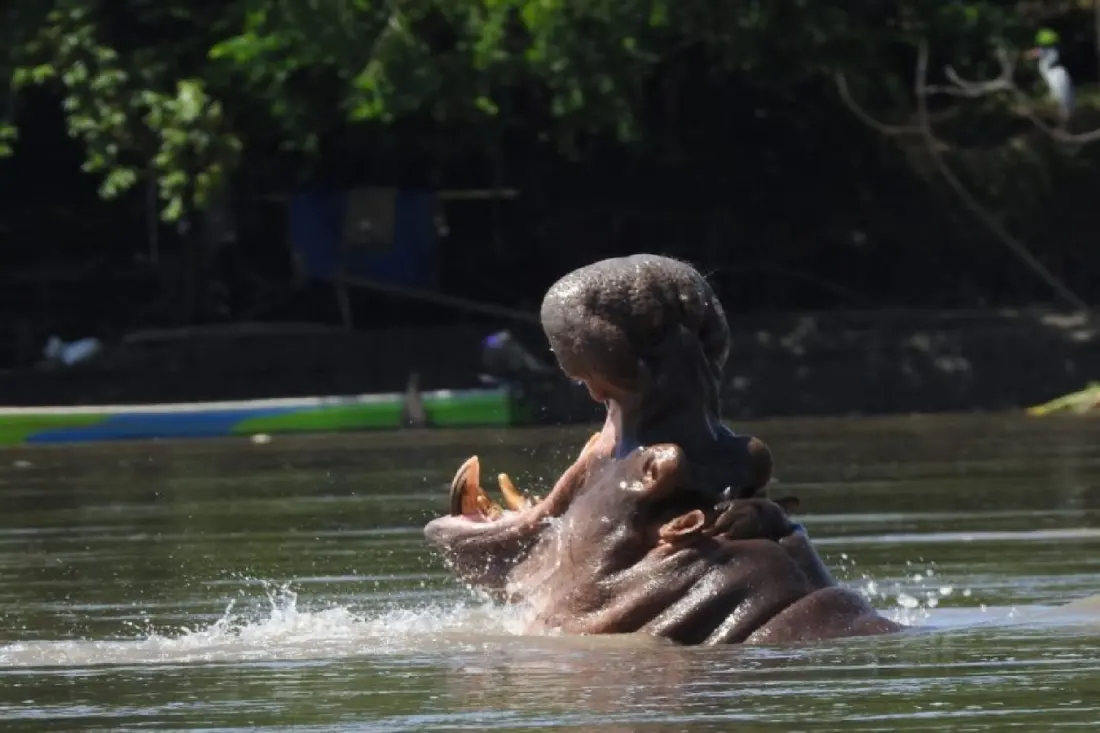
Colombia has officially begun culling the famously rogue hippopotamus population descended from Pablo Escobar's private zoo. On 18 November, the environment ministry and CORNARE, the regional environmental authority for the Negro and Nare river basins, signed an agreement launching the first phase of a population-control plan, starting with the euthanasia of ten animals over roughly four months.
Why these ten? Because they're the ones causing trouble close to people. One adult hippo shares the Nare River with the route 23 children take by boat to school in Puerto Nare, Antioquia — a local court had already ruled in the kids' favour in a guardianship case and ordered urgent protective measures. Others selected roam near homes in Doradal, in the municipality of Puerto Triunfo. "There is a school, there are children, we have to act," CORNARE director Javier Valencia told El Colombiano.
This isn't a blanket cull. The plan mixes interventions — chemical euthanasia for the highest-risk animals, but also sterilisation, transfers and monitoring. A bioethics committee and a technical group led by CORNARE will oversee decisions. Authorities are still waiting on imports of Etorphine, the drug used to immobilise the animals, and South African hippo-handling experts arrive at the end of November to advise the team. Subduing a three-tonne hippo can take up to seven darts, and each euthanasia procedure may cost more than 40 million Colombian pesos — about US$12,000.
The backstory: these hippos trace back to Escobar's Hacienda Nápoles estate, and after his death the animals multiplied unchecked in the Magdalena River basin. CORNARE now estimates 250 to 260 in the wild, though it admits that count needs updating. Colombia declared them an invasive exotic species in 2022, citing damage to aquatic ecosystems and the danger they pose to riverside communities. Past efforts include 35 surgical sterilisations, zoo transfers, immunocastration trials and telemetry tracking — though some animals have shed or broken their tracking devices. A proposed sanctuary scheme backed by India's Vantara organisation, which wanted to relocate the hippos abroad, collapsed recently on technical grounds.
For travellers, the practical takeaway is straightforward: this is cattle-country river territory, not a safari zone. The hippos live around the Nare and Magdalena rivers between Medellín and Bogotá, an area some visitors pass through en route to Hacienda Nápoles, now a theme park built on Escobar's former estate. If you're heading there, stick to marked areas, take local advice seriously near the rivers, and don't expect to see a hippo — that's increasingly the point. Officials are trying to reduce a population that threatens both wildlife and the people who share the water, not to add photo opportunities.
The story is a rare case of a country openly wrestling with an iconic invasive species — balancing animal welfare, court rulings and community safety — and it's likely to shape how the region markets (or doesn't market) its unlikely hippo legacy. — Colombia One