
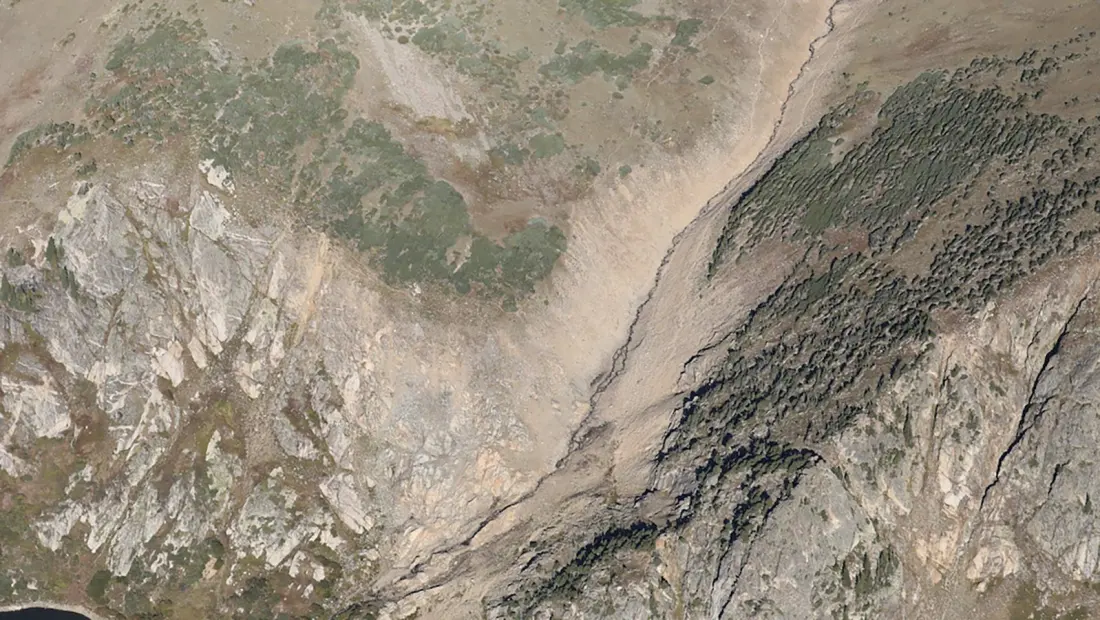
The year-round snowfield known as St. Mary's Glacier, a fixture of Colorado's Front Range for more than a century, melted out entirely this September — the first time in recorded history that nothing but a rocky puddle remains in the gully.
Strictly speaking, St. Mary's was never a true glacier but a permanent snowfield, and it held a special place in local life: the closest year-round snow to the Denver metro area, just 45 minutes from Golden. Victorian-era city dwellers hiked up to escape the summer heat back in the 1800s. In recent decades it became the go-to spot for summer camps, school field trips, and a quirky Front Range tradition — skiers slogging up in July and August to earn year-round turns on slushy snow.
The end didn't come out of nowhere. According to Dan McGrath, a geosciences professor at Colorado State University who maps the state's glaciers using aerial LIDAR imagery, the past 12 months delivered a fatal combination: the worst winter snowpack in 40 years, followed by the hottest summer on local memory. "It was not surprising that St. Mary's melted out," he told Outside Online, adding that Colorado's snowfields are proving far more climate-sensitive than expected.
The wider picture is grim. At nearby Andrews Glacier in Rocky Mountain National Park, McGrath's team measured thinning of about six inches a year through the 2010s, accelerating to three feet annually from 2020 to 2024. Then, in the winter of 2025-26, it thinned by 11 feet — a threefold jump in a single year. Andrews survived, but the Arapahoe Glacier above Boulder is barely holding on, and Isabelle Glacier near Brainard Lake has shrunk to patches of brown ice.
Could St. Mary's come back? In theory, snowstorms will keep filling the shaded drainage. But McGrath compares the snowfield to a savings account that's been drained: a good snow year might rebuild a little, yet it would take many years of accumulation to restore what was lost — and summers keep getting hotter. For now, a defining piece of Colorado recreation and identity is simply gone, mourned by generations who grew up sledding and snowball-fighting there in mid-summer.
For travellers, this is a quiet reminder that the era of reliable year-round snowfields near major cities is closing. You can still hike the trail to the gully and see the basin that held the snowfield, and Rocky Mountain National Park's Andrews Glacier remains reachable for now — but if glaciers and permanent snow are on your bucket list, the window in Colorado is narrowing fast. Go with realistic expectations: what was once a gleaming summer snowfield is now, for the first time, bare rock and meltwater.