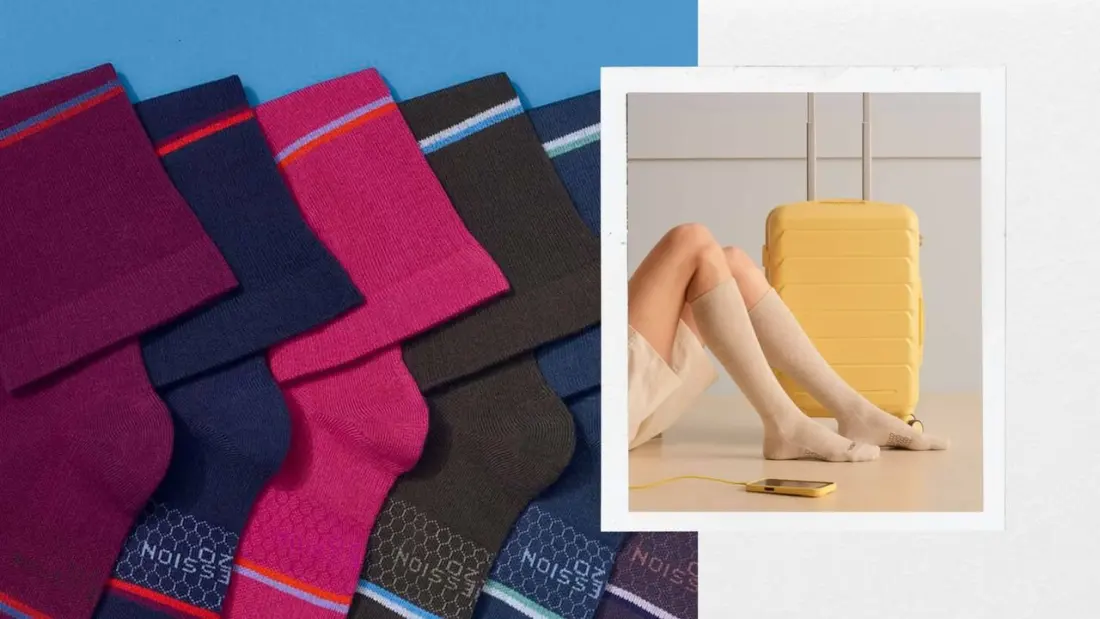
Sitting cramped in an economy seat for ten-plus hours does uncomfortable things to your legs. Swelling, pins and needles, that heavy feeling when you finally stand up — it's the price many of us pay for getting anywhere far. One cheap fix keeps coming up among frequent fliers: compression socks.
The idea is simple. These snugger-than-normal socks apply gentle pressure to the veins in your ankles and calves, which helps blood keep moving back up toward your heart instead of pooling in your feet. The payoff is better circulation, less puffiness, and noticeably less aching after hours of stillness — whether you're on a plane, a long train ride, or a road trip.
There's also a health angle worth knowing. By keeping blood flowing, compression socks can help reduce the risk of deep vein thrombosis — a rare but serious condition where a clot forms in a deep vein and can travel to the lungs. They also help with muscle recovery, which is why athletes wear them too, and can ease swelling linked to varicose veins and pregnancy.
Not all pairs are created equal, and the numbers on the packaging matter. Compression strength is measured in millimeters of mercury (mmHg). Casual travel socks usually sit at 15-25 mmHg, which is enough to encourage circulation without feeling restrictive. Medical-grade pairs run 20-30 mmHg — a step up if your doctor recommends it — while anything around 30 mmHg is extra tight and 10 mmHg is fairly loose. If you're unsure what level suits you, a quick chat with your doctor is a sensible first move, especially if you're pregnant, prone to swollen legs, or have circulatory concerns.
One label to look out for: graduated compression. These socks are tightest at the ankle and gradually loosen toward the top, which actively pushes blood upward. For travellers who find uniform tightness uncomfortable, graduated pairs tend to be the comfiest compromise.
As for what makes a good travel pair, the editors' criteria are refreshingly practical: firm enough to actually do something, easy to pull on and off (no small feat in an aeroplane toilet queue), and soft enough to wear all day.
So who should bother? Honestly, most of us. If your next trip involves more than about four hours seated — think Europe from the US, or Australia from pretty much anywhere — a pair costs relatively little and takes up almost no luggage space. Slap them on before boarding, and your ankles will look and feel considerably less like balloons by the time you land.