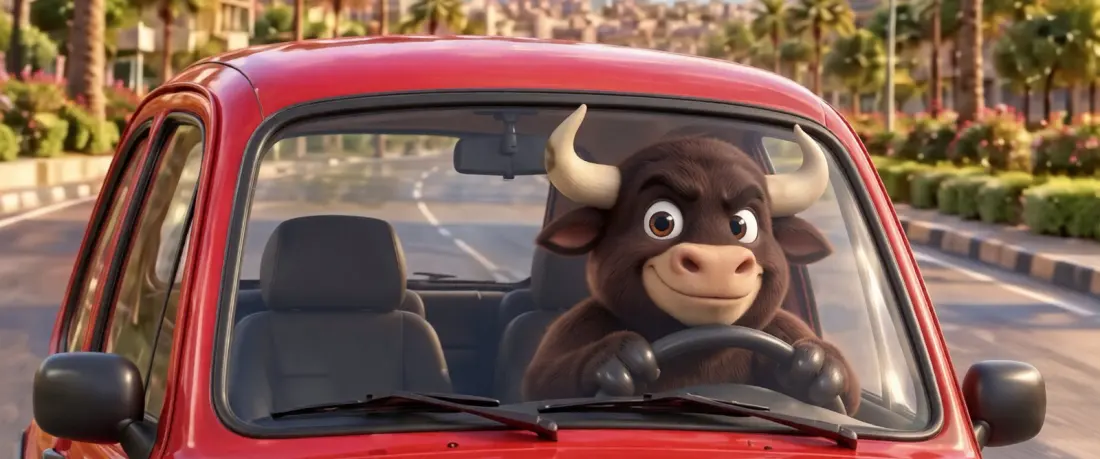
Egyptian drivers now have a mirror held up to them — and it's an animated character named Bahima. The Instagram page Not a Bahima (roughly 'Not a Brute') launched on 7 October 2026 and picked up around 67,000 followers within weeks, all by lampooning the everyday absurdities of driving in Egypt: intersections blocked, lanes ignored, parking spots treated as conquests.
The creators are Tarek Elsamni, a 36-year-old Egyptian, and his wife Yasmen Khorshed. Elsamni spent 12 years living between Britain and other European countries and only properly learned to drive in Denmark — failing the test three times before passing. That experience, he says, showed him how many habits he'd picked up on Egyptian roads were simply wrong. After moving back to Egypt in 2024, he and his wife started using 'Bahima' — slang for an animal or brute — as shorthand for every reckless manoeuvre they witnessed.
Tired of lecturing strangers at traffic lights, he turned the joke into content. Each 30-60 second video shows Bahima doing exactly what not to do behind the wheel, built with a consistent character identity, captions and a signature sound, with AI tools helping draft scripts and visuals. One minimalist reel hit roughly 1.5 million views in 24 hours. Rapper Wegz is among the page's notable fans, and followers now send in their own road horror stories to fuel new episodes.
Elsamni is careful about the tone: the target is behaviour, not people. He also pushes back on the excuse that Egypt's infrastructure is to blame, noting that bad habits persist even inside well-paved gated compounds like Mivida, and that marked lanes elsewhere in the country get ignored all the same. He doesn't pretend reels can fix national traffic culture — 'we can try' is as far as he'll go — but he points to his own wake-up call, when his daughters called him out for driving exactly like the character he mocks. His fix: leave 15 minutes earlier.
There's more in the pipeline than videos. The team is exploring QR-code stickers a driver could hand over instead of arguing — the code links to a short video explaining the specific mistake — plus a board game for two to eight players built around familiar traffic standoffs, with a rulebook doubling as a driving-etiquette guide.
Why should travellers care? If you're planning to rent a car, hail ride-hailing apps or simply cross the street in Cairo, this page doubles as a surprisingly useful primer on local road culture — what to expect, why it happens, and how locals themselves feel about it. It's also a fun follow for anyone who has ever gripped the dashboard in a Cairo taxi and wondered whether it was just them.