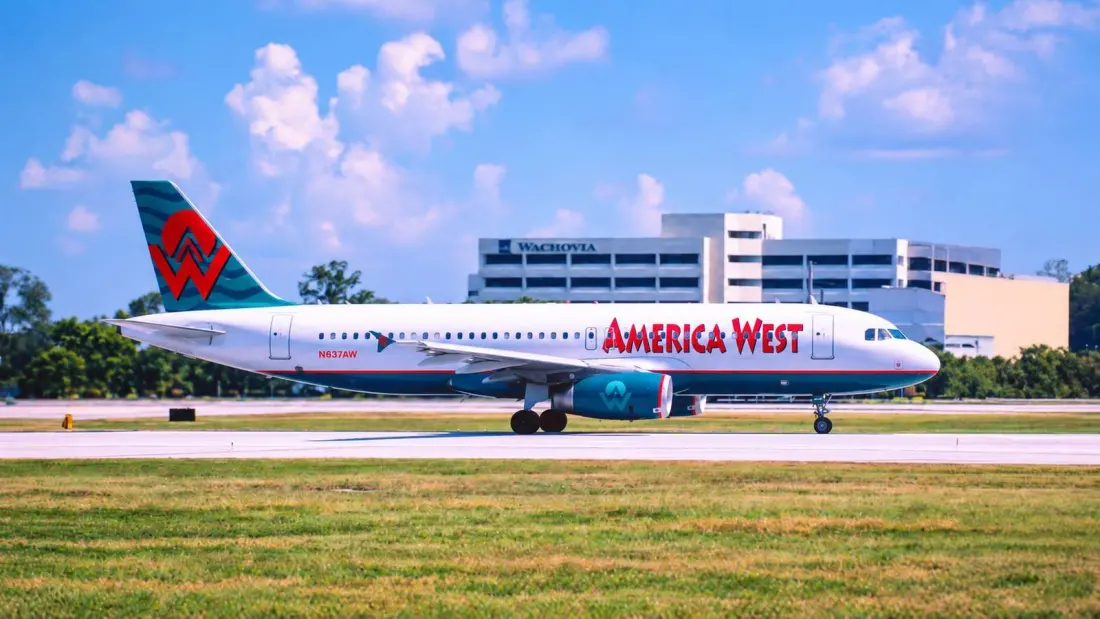
In February 2003, America West Airlines did something that would have seemed unthinkable a few years earlier: it dismantled an entire hub in a single announcement. Columbus, then Port Columbus International Airport and now John Glenn Columbus International, went from 49 daily departures across 15 destinations to just four flights a day. CEO Doug Parker's decision cut more than 90% of the airline's flying there and shrank the local workforce from roughly 400 staff to 65.
America West had launched Columbus service in December 1991 with five daily departures and built it into the carrier's third hub, alongside Phoenix and Las Vegas. The strategy leaned heavily on 50-seat Embraer ERJ-145 regional jets operated by Chautauqua Airlines under the America West Express brand, feeding passengers from smaller Midwestern and East Coast cities into connecting flights. By 2002 the operation carried more than 700,000 departing passengers a year, making it the airport's biggest airline group. But it was bleeding around $25 million annually, and after the post-9/11 downturn the numbers stopped adding up.
The real problem was that the hub had made itself redundant. Longer-range aircraft like the Boeing 757-200 allowed America West to fly nonstop from Phoenix and Las Vegas to major eastern cities, so fewer people needed to change planes in Ohio. Add crowded regional-jet competition across the East and Midwest, plus Southwest Airlines' rapid growth since arriving at Columbus in June 1992, and fares and connecting traffic came under pressure from every direction. When the cuts landed between April and June 2003, 12 regional jets were withdrawn, 13 destinations disappeared, and only a pair of daily flights each to Phoenix and Las Vegas survived. The airline also gave up its LaGuardia operation because the airport's 1,500-mile perimeter rule barred nonstops from either of its western hubs.
Columbus wasn't a one-off. St. Louis lost its TWA-and-then-American hub, Delta wound down its enormous Cincinnati operation, Memphis fell after the Northwest merger, and United pulled out of Cleveland in 2014. The connecting-hub model that defined 1980s and 1990s US aviation simply couldn't survive once bigger hubs, cheaper nonstops and low-cost carriers like Southwest, JetBlue and Frontier offered passengers better options.
There's a modern echo, too: Delta's current build-up at Austin, targeting more than 70 daily departures by summer 2027 including a new Paris route, shows airlines now grow city-by-city rather than betting on classic connecting hubs. American's earlier attempt at a huge Austin expansion had already been dialled back. Notably, the GAO found Columbus's overall traffic actually rose slightly after America West left, as Southwest and others picked up the slack.
For today's traveller, the story explains why your mid-sized airport may have fewer connections than it once did, and why nonstop service to big cities is the prize airlines now chase. The executives behind the Columbus decision, Parker and Scott Kirby, went on to run American and United, shaping the industry you fly in today.