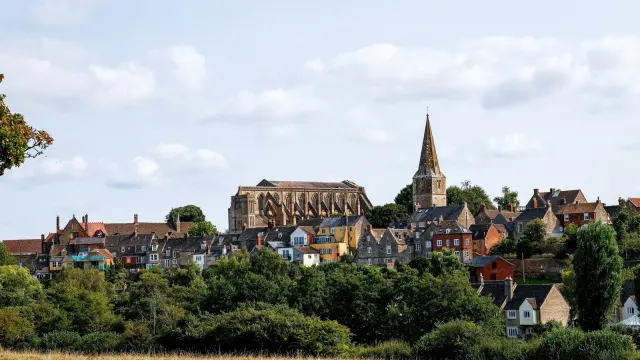
Bury St Edmunds looks like the poster child for a genteel Suffolk weekend — medieval houses, a lovely abbey park, a cathedral, independent shops. But this market town holds an uncomfortable record: England's largest witch trial. In August 1645, more than 100 people were carted in from surrounding villages, 18 were convicted and hanged, all victims of the self-styled Witchfinder General, Matthew Hopkins.
The story gets a proper telling in Crime and Superstition, a new exhibition opening on Halloween at Moyse's Hall Museum. Alongside the witch trial history, the museum displays the era's stranger protective customs: mummified cats and hidden shoes used as 'ritual deposits' to ward off evil spirits, witch bottles filled with urine and pins to skewer incoming spells, and a cursing doll. There's also a rare copy of A Tryal of Witches, the account of the local trial of Amy Denny and Rose Cullender — a document that later shaped the infamous Salem witch trials by allowing children's hearsay and 'spectral evidence'. For good measure, the museum also holds a gibbet cage, a man trap, and the death mask and scalp of William Corder, hanged for the Red Barn Murder; his book bound in human skin is part of the display.
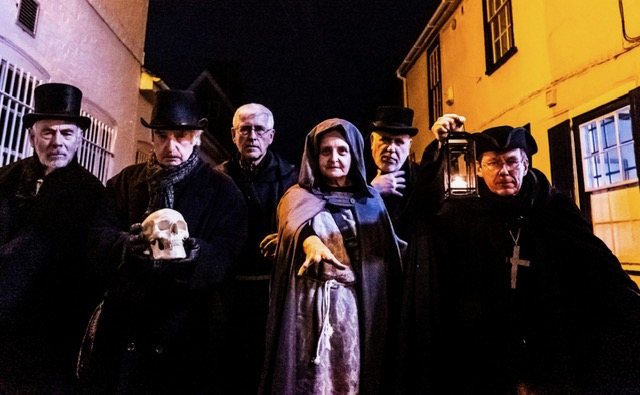
The darkness extends beyond the museum walls. Costumed guides run a Ghostly and Macabre Walk past haunted sites: the Grey Lady, spotted in the cathedral churchyard, the abbey ruins and the Priory hotel; a Crimea nurse and her murdered soldier lover; a little boy upstairs at the Nutshell pub; even unexplained kettle-boiling at the local Body Shop. The walk also takes in the Charnel House and the memorial to 17 Protestant martyrs burned under Mary Tudor — and drops the etymology that 'bonfire' began as 'bonefire'.
Bury isn't all doom. A daytime guided walking tour covers St Edmund, England's original patron saint, martyred by Vikings in 869, and the vast Benedictine abbey built around his shrine, which once owned a third of Suffolk and drew pilgrims from across Christendom. It was here that 25 barons first resolved to curb King John's power, the spark that led to Magna Carta. There's also the 800-year-old Guildhall, St Mary's Church (tomb of Henry VIII's sister), a cathedral with a 200,000-piece Lego model, and the Nutshell — England's smallest pub at 15ft by 7ft, its ceiling papered with foreign banknotes and a mummified cat watching over the bar.
For travellers who like their history with a shiver, this is an easy, compact trip: a walkable town where a weekend can combine haunted walks, a genuinely unsettling museum exhibition, abbey ruins and a decent pint. Halloween is the obvious time to go, but the exhibition and tours run year-round.