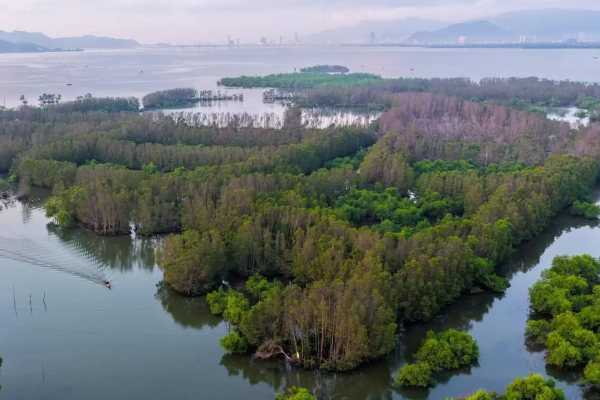
Skip Vietnam's beach strip for a moment and head inland to Thi Nai Lagoon, near Quy Nhon in Binh Dinh province. Here, Con Chim Islet sits at the heart of a vast wetland, its maze of mangrove roots sheltering one of the region's most rewarding bird spectacles — and barely any tourists.
The islet functions as a sanctuary for herons, egrets and other waterbirds that have grown scarce elsewhere along the coast. The payoff comes in the late afternoon: as the light fades, thousands of birds take to the air in loose, wheeling flocks before dropping onto the mangrove canopy to roost for the night. It's a mass arrival that lasts a while and rewards anyone patient enough to sit and watch. Early risers get a different version — dawn is quieter, with mist on the water and birds stirring rather than flocking.
Getting around is refreshingly low-tech. Local boatmen run trips from piers along the lagoon's edge, winding through green tunnels of mangrove where the only soundtrack is paddles and the odd splash. Stand-up paddleboards are also an option if you'd rather set your own pace. Either way, you'll likely pass fishermen casting nets much as their families have for generations — the lagoon is a working landscape, not just a nature set piece.
Part of what makes Con Chim interesting is its backstory. The area has been the focus of habitat rehabilitation and sustainable fisheries projects, so the bird life you see today is partly the result of deliberate restoration work rather than pure luck. That makes it a good example of the kind of low-impact ecotourism Vietnam is quietly getting better at.
Who is this for? Travellers who've done Hoi An's lanterns and Ha Long's junks and now want something genuinely off-script. There are no ticket booths, no gift shops — just water, birds and boats. Pair it with Quy Nhon's underrated coastline and you've got a southern-central Vietnam trip most people haven't heard of yet.
Practically speaking: plan to spend a full day on the lagoon and stay through the dusk return — that's the headline act. Bring binoculars if you have them, a camera with a decent zoom, and insect repellent for the mangroves. Access is easiest through Quy Nhon, which has its own airport with connections to Hanoi and Ho Chi Minh City.