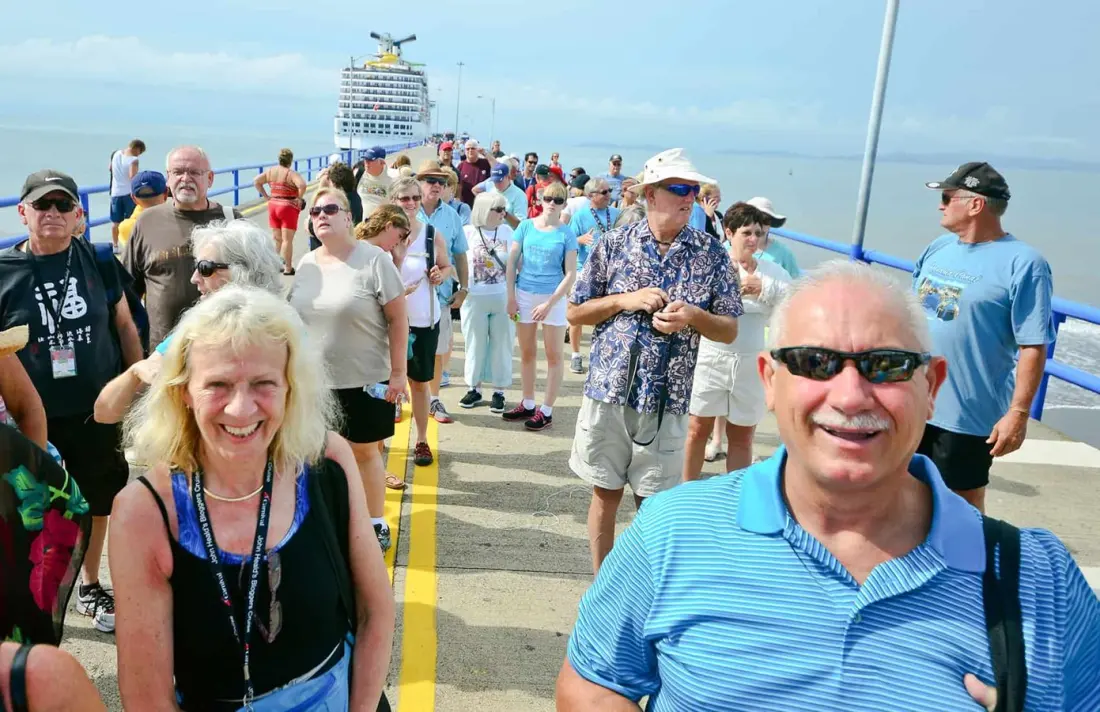
A cruise day in Costa Rica looks lively from the pier at Puntarenas or Limón — thousands of passengers pouring ashore for a few hours of zip lines and souvenirs. But a detailed study of the 2023/2024 season suggests the country keeps a surprisingly small slice of that spending, while the question of what ships discharge into its waters remains only partly answered.
The research, carried out by consultancy Business Research and Economic Advisors for the Florida-Caribbean Cruise Association and destinations including the Costa Rican Tourism Institute, found the average shore-going passenger spends $72.74 — roughly 33,100 colones. Sounds decent, until you look closer. About 80% of passengers bought an excursion, and 85% of those were sold on board by the cruise lines, which take their cut before a colón reaches the local operator. Just 4% of tours were booked directly ashore. Strip out tours and spending falls to about $20 per person: $6.25 on crafts, $5.25 on clothing, a measly $2.55 on food and drink — unsurprising when meals are already paid for on the ship.
Over the whole season, around 228,000 passenger visits generated $16.6 million in spending, of which roughly $4.7 million stayed outside the tour economy. Add crew spending, port fees and line-paid services and the total reaches $32.2 million, supporting 852 jobs. Notably, the tourism institute has long claimed passengers spend about $137 a day — nearly double what the survey actually measured. And passenger enthusiasm is fading: overall ratings slipped from 8.2 in 2018 to 7.8 out of 10, with the likelihood of returning for a land holiday scoring just 4.5.
Then there's the waste. Under the MARPOL convention, ships can release treated sewage close to shore, disinfected sewage beyond three nautical miles and untreated sewage beyond 12, while graywater is barely regulated at all. Costa Rica spent decades outside the convention — its Constitutional Chamber blocked accession in 1999, citing a lack of facilities and trained staff — and an analysis for the Pacific port authority found no national rules on discharge and no requirement for ports to receive ship waste. Law 10738 approving MARPOL accession passed in June 2025, but the final step, formally depositing it with the International Maritime Organization in London, had not been publicly confirmed as done as of November 2025.
Meanwhile there's no public reception facility in port. Ships can hire private contractors — the Atlantic port authority JAPDEVA now requires its waste contractors to prove disposal at Environment Ministry-authorized facilities — or simply hold waste and release it at sea, beyond any Costa Rican inspection. Sociologist Roger Ríos of UNED has urged that the new 30-year Puerto Caldera concession, still tied up in court over an environmental challenge, mandate proper waste reception; he notes some shipping lines add Panama or Colombia stops for those services instead.
For travellers, the takeaway is twofold: booking tours directly with local operators puts far more money into the communities you're visiting, and Costa Rica's push for bigger ships and new terminals makes it worth watching how the country balances cruise growth against the health of its own coasts.
Reporting by The Tico Times.