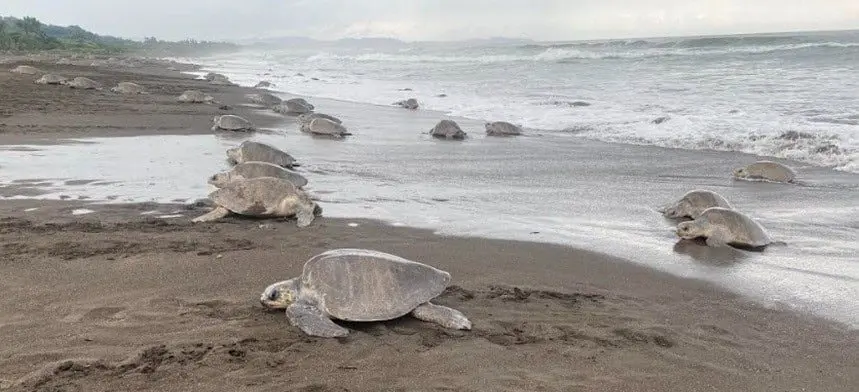
Something remarkable has been happening on a stretch of Pacific coast in Guanacaste, Costa Rica. Since September 2026, roughly 347,000 female olive ridley sea turtles have hauled themselves onto the sand at Ostional National Wildlife Refuge to lay their eggs — and the mass nesting, known locally as an arribada, has now lasted more than 50 days. Costa Rica's Ministry of Environment and Energy (MINAE) says no comparable event appears anywhere in the historical record, either at Ostional or at any other turtle beach worldwide.
Arribadas themselves aren't rare at Ostional, which hosts multiple nesting waves each year and is considered one of the world's most important sites for olive ridleys. What makes this one extraordinary is the sheer scale and duration. For context, recent peak months were far smaller: about 307,000 turtles in September 2021, 206,000 in November 2022, then 111,000, 160,000 and 190,000 in the busiest months of 2023, 2024 and 2025. Costa Rica has counted 11 arribadas at Ostional in 2026 alone, but none like this one.
Why did so many turtles arrive at once, and stay so long? Nobody knows yet. One working hypothesis is that females from different populations across North and South America converged on the same beach in the same window. Scientists from FUNDECODES and rangers from the Tempisque Conservation Area monitored the nesting around the clock, and refuge administrator Carlos Pizarro has stressed that ongoing monitoring will be needed to test the convergence theory against historical data. Researchers at the site are also looking at pollution exposure in the turtles, so the beach doubles as a living laboratory.
Local communities have been credited with protecting the nesting beaches, which matters — Ostional's arribadas draw visitors, and well-managed tourism and conservation go hand in hand there.
For travellers, this is one of the most spectacular wildlife events you can witness on foot. If a quarter-million-plus turtles crawling ashore sounds like your kind of night out, the rules are strict but simple: you can only enter the beach with an authorised local guide, you must not touch turtles or disturb nests, and flash photography is banned during nighttime nesting. The eggs and hatchlings are protected, so following your guide's instructions is part of the deal.
Ostional sits on the Nicoya Peninsula side of Guanacaste, typically reached via the towns of Nosara or Samara, both of which pair well with a turtle trip — surf beaches, yoga retreats and wildlife refuges are all within short drives. Arribadas are unpredictable by nature (they often correlate with lunar cycles and rainy-season months), so build some flexibility into your schedule rather than banking on a specific date. Even outside a record event, smaller nestings happen regularly, and hatchling releases are common in the right season. If you're flexible and lucky, you might catch nature in the middle of rewriting its own record book.