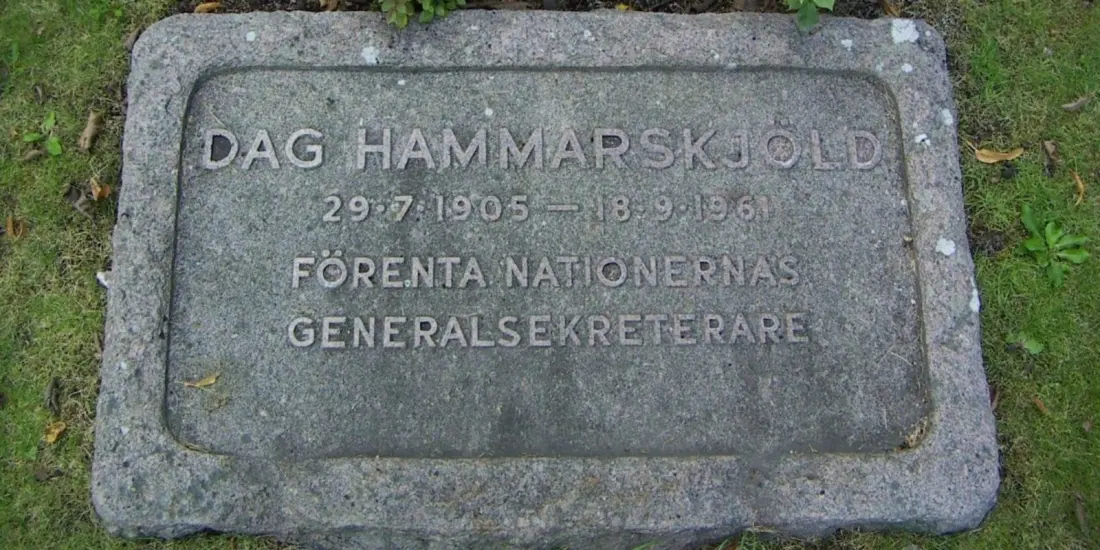
On a quiet hillside cemetery in Uppsala, Sweden, lies the grave of Dag Hammarskjöld — a spot far removed from New York and from the crises the United Nations was built to stop. Sixty-five years have passed since the second UN Secretary-General died on 18 September 1961, aged 56, when his plane crashed near Ndola in what is now Zambia. He was flying in to negotiate a ceasefire in the Congo, where the secession of the mineral-rich Katanga province had pulled a newly independent state into conflict and great-power rivalry.
Writing in Nepali Times, former UN and Carter Center official Jordan Ryan uses the anniversary to take stock of Hammarskjöld's legacy and of the vacancy his successors keep trying to fill. Hammarskjöld practised what became known as preventive diplomacy: travelling into crises early, negotiating before positions hardened, and keeping the UN present where member states could not or would not go. Suez, Lebanon and the Congo were all different emergencies, but he treated them as the same craft. He did not always succeed — the point was that he considered prevention part of the job.
Every Secretary-General since has restated that principle. Boutros Boutros-Ghali turned it into doctrine with An Agenda for Peace, Kofi Annan built early-warning and mediation capacity, Ban Ki-moon issued the first report devoted to the subject in 2011, and António Guterres made the case again in A New Agenda for Peace. Doctrine, Ryan argues, is not what is missing. The problem is political: a crisis that never happens leaves no ruins, no refugees and no peacekeeping budget to justify the spending, so governments pay readily for war and reluctantly for preventing it. Sudan, eastern Congo, the Sahel, Burma and Gaza all show warnings accumulating while the room to act shrinks.
The piece lands on the selection of Guterres' successor, and on what the office should do when information is flowing but the Security Council is blocked. Hammarskjöld faced a version of that test in 1960, when Nikita Khrushchev demanded his resignation and proposed replacing the role with a three-person 'troika' of rival blocs. Hammarskjöld refused, telling the General Assembly it was easy to bow to a big power and another matter to resist — and that the UN existed not for the great powers, who have other means of protecting themselves, but for "all the others".
For travellers passing through Uppsala, Hammarskjöld's grave is a genuinely notable stop: this quiet Swedish university city, 70-odd kilometres north of Stockholm, is where the UN's most consequential Secretary-General lived, worked and is buried. The anniversary is a reminder that the ideas tied to that simple grave still shape conflicts travellers see in the news.
Jordan Ryan's article was issued by the Toda Peace Institute and republished by Nepali Times.