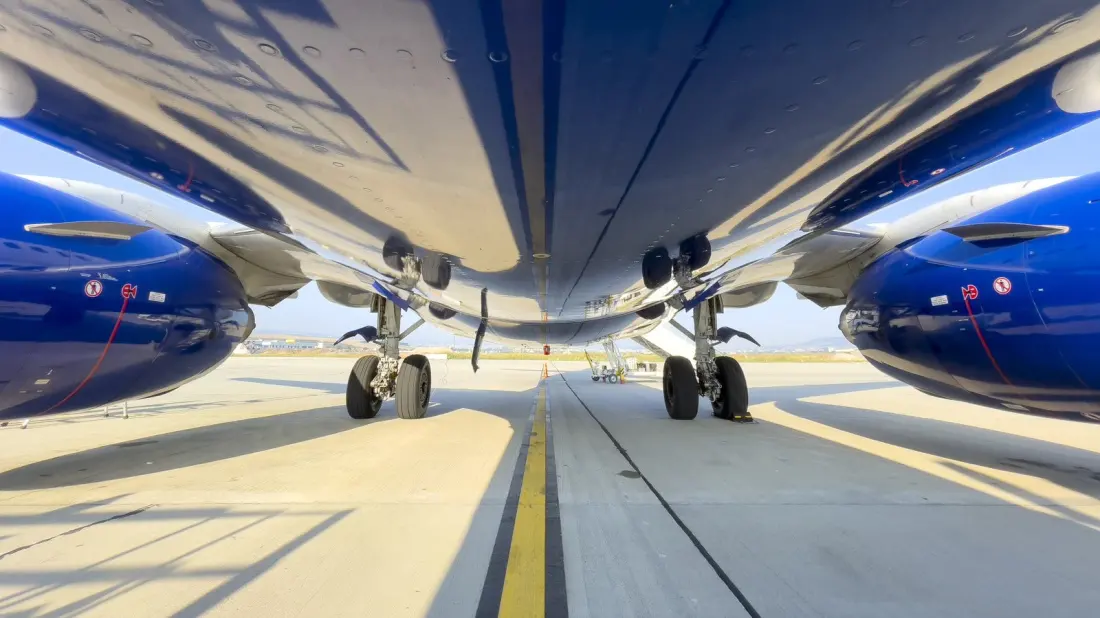
Ever watched a plane crawl towards the runway and wondered what all the painted lines actually mean? There's a surprisingly tidy system at work, and nearly every mark you see outside the runway itself is yellow. The FAA's rule is simple: taxiways, holding positions, and closed or hazardous areas all get yellow paint, while the runway proper is marked in white.
The standardisation is deliberate. Pilots landing at an unfamiliar airport on another continent can read the pavement the same way they would back home, cutting out confusion that language barriers with air traffic control could otherwise create. For a system moving millions of flights safely every year, that consistency matters more than you'd think.
The most common marking is the taxiway centreline — a long, unbroken yellow stripe that leads aircraft between runways, terminals and hangars. At junctions with other taxiways, the edges switch to short dashed lines; elsewhere, edges are drawn as continuous lines so pilots can keep the aircraft within its lane. Then there's the one most travellers have probably stared at without knowing its name: the runway holding position line. Four lines total — two solid, two dashed, running parallel — mark where a pilot must stop and wait for explicit clearance before entering a runway. If you've ever sat near the end of a runway watching planes queue, you've seen this line doing its job.
Bigger airports add extra layers. Chicago O'Hare, ranked America's most connected airport in 2025, uses an enhanced centreline with parallel dashes on either side of the main stripe, helping crews navigate a notoriously busy taxiway network. Shoulder areas — paved strips running alongside runways and taxiways to protect them from erosion — aren't strong enough to carry aircraft, so they're marked with yellow stripes running perpendicular or diagonal to the active surface, a clear visual signal to stay off.
Out-of-bounds zones are handled just as clearly. Sections that look like extra runway but can't take live traffic are painted over with chevron patterns — V-shaped yellow lines covering the whole area. The border between usable runway and these no-go zones is a demarcation bar, a yellow strip three feet wide running the full width of the pavement.
Why should a traveller care? Partly because it demystifies those long taxi rides after landing — every pause at a four-line intersection is a pilot waiting for permission, not a delay caused by confusion. Mostly, though, it's a reminder of how much invisible infrastructure underpins the safety of a routine flight. Air travel's strong safety record isn't luck; it's built on visual systems like these that let pilots, controllers and ground crews coordinate without a single word being spoken. Next time you're by a window seat, you'll know exactly what you're looking at.