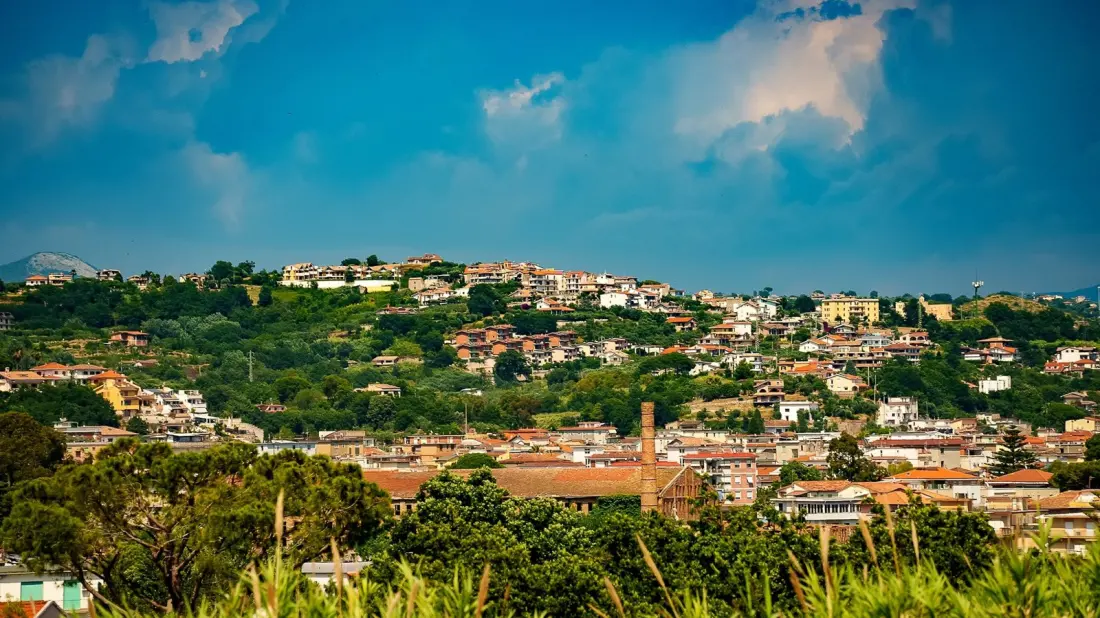
Halfway along the Rome–Naples rail line sits Minturno, a hilltop town on the Gulf of Gaeta that most travellers speed past without a glance. That's their loss. It pairs centuries of medieval history with the sort of low-key beach resort atmosphere you'd normally drive hours down the coast to find — and it's reachable from either big city in roughly an hour to ninety minutes.
The old town is the draw for history fans. The Caracciolo Carafa Ducal Castle anchors the centre with views stretching across the Tyrrhenian Sea, while the ninth-century Church of San Pietro Apostolo mixes marble pillars, arches and Baroque interiors. Older still is the town's Roman legacy: the ancient aqueduct's surviving stone arches once channelled spring water into the city, and just downhill, the Parco Archeologico di Minturnae e Ponte Real Ferdinando holds a Roman theatre dating to the first century A.D. alongside an 1832 iron suspension bridge — one of Italy's first.
Below the hill, the seaside districts of Scauri and Marina di Minturno run along about 4.5 miles of coast, a blend of sand and pebble beaches plus small coves. The standout swim spot is Spiaggia dei Sassolini, a pebbled cove with clear, shallow water framed by cliffs — umbrellas and sunbeds available in summer. If you want more than sunbathing, you can rent a kayak and paddle to the Grotta Azzurra sea cave along the gulf.
Where to stay depends on your style. Hotel La Rosetta is a well-reviewed pick with sea views, a restaurant serving regional dishes and local wine, plus summer access to a beach club and private gazebos. Families might prefer Residence Scauri Case Vacanze, holiday apartments directly across from the sandy beach with private terraces.
Practically speaking, Minturno-Scauri station puts the town on the Rome–Naples line, so it works equally well as a day trip or a base for a slow coastal week. It sits in Lazio, a region full of under-the-radar towns, and if you want to extend the trip, Gaeta — a similarly uncrowded coastal city — is close by.
For anyone who loves the idea of an Italian seaside holiday but dreads the Amalfi crowds, this is the alternative: mornings among medieval staircases and castle walls, afternoons with an Aperol spritz on a quiet beach, all without fighting for space.