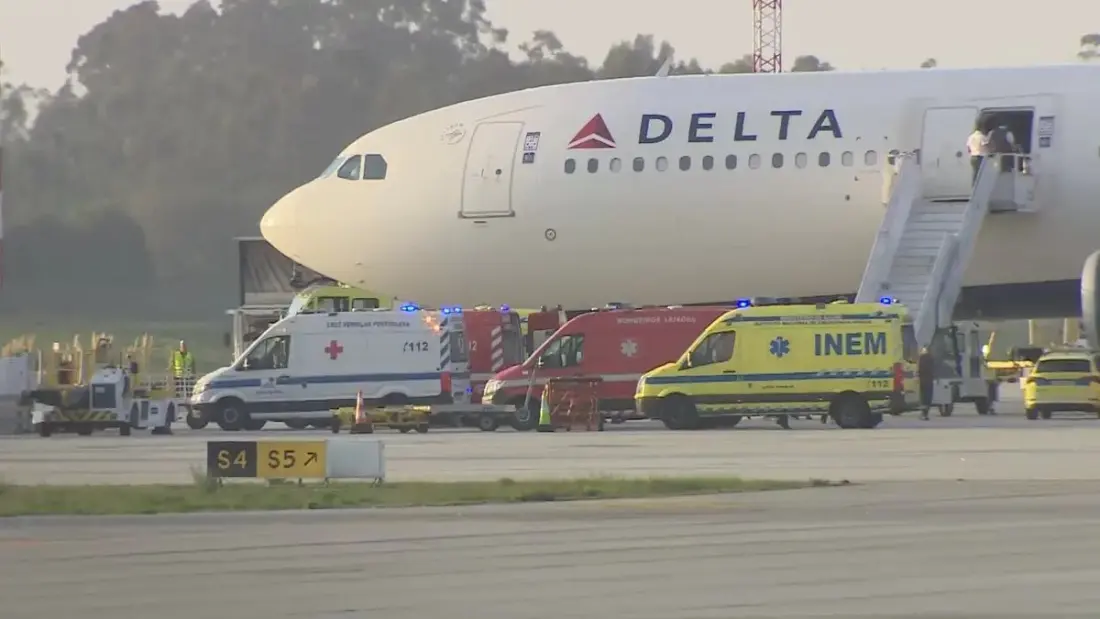
A Delta Air Lines flight bound for Boston made an emergency landing at Porto's Sá Carneiro Airport on Thursday evening after smoke was detected in the cabin mid-Atlantic. Fourteen of the 296 people on board were treated for smoke inhalation, and four of those were taken to nearby hospitals for further care. The remaining 282 passengers got out unharmed.
Flight DL251 had left Barcelona at 3pm and was over the ocean when the crew spotted the smoke. Rather than press on towards the US coast, they turned back to Porto, where authorities activated a level-two alert — the protocol that puts emergency crews on standby ahead of an arrival. Air traffic at the airport was halted for a few minutes while the aircraft came in, then resumed as normal. Around 60 emergency personnel attended, with additional resources mobilised and then stood down once it became clear they weren't needed.
The aircraft involved was an Airbus A330, roughly 11 years old according to tracking site Airlive.net. Early indications point to a "technical problem" as the cause, though the exact fault had yet to be identified. Delta has since arranged a replacement flight for the following afternoon, but the disruption ripples beyond this one sector: with the plane and its crew out of position in northern Portugal, the airline cancelled its connected flights DL276 and DL277, and flagged wider cascading schedule changes.
For anyone booked on a transatlantic Delta routing through Barcelona or Porto in the coming days, it's worth keeping an eye on the airline's app or website for knock-on delays and rebooking options.
Situations like this are rare, but they're a useful reminder of how Europe's secondary airports get pressed into service. Porto's Sá Carneiro handles plenty of holiday traffic to northern Portugal and the Douro Valley, and this week it proved it can also absorb an unscheduled widebody diversion without much drama. If you're flying long-haul from Iberia and your flight doubles back mid-Atlantic, landing at a city like Porto is about as good an outcome as you can hope for — wine cellars, decent hotels and a well-connected airport included.
The takeaway for travellers is fairly straightforward: smoke in a cabin is serious, but crews train for exactly this, and the fact that 282 people walked away unhurt says the system worked. Fourteen passengers needed treatment, four remain in hospital, and the cause is now under investigation. Delta, for its part, moved quickly to rebook the stranded passengers onto a flight the next day — a reminder that when a diversion strands you in the wrong country, the airline is responsible for getting you onward, so keep your booking reference handy and document any extra costs like meals or accommodation in case you need to claim them later.