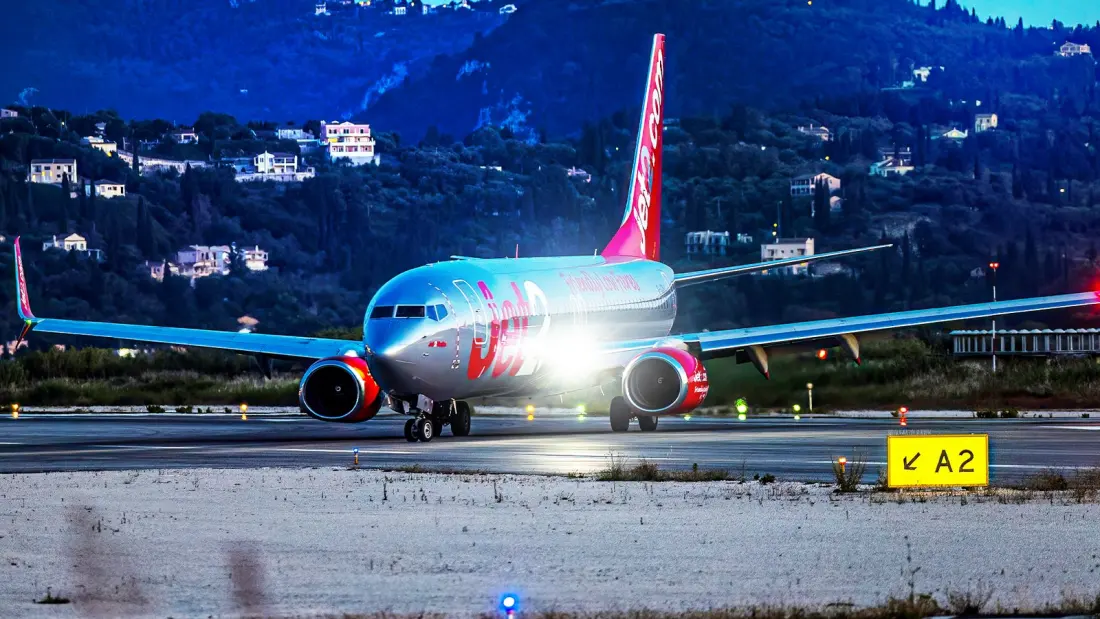
If you've watched an older Boeing 737 on approach, you may have spotted small lights mechanically folding out of the fuselage. Those retractable landing lights were a fixture of the 737 for decades - until Boeing quietly scrapped them in 2015.
The system dated back to the original 737 of the late 1960s, when the lights extended below the outboard flap track bearings. By the 737 Next Generation era, they had moved to the fuselage belly under the engine ram air intakes, worked by a three-position cockpit switch labelled RETRACT, EXTEND and ON. Pilots would extend the lights first, then switch them on once clear of low cloud or fog to avoid being dazzled by reflections.
So why bother retracting them at all? Drag. Even small landing lights sticking into the airflow cost fuel - an extended set burns roughly 26.5 lb (12 kg) of extra fuel on the climb from takeoff to 10,000 feet, and leaving them out full-time reportedly adds around 2% to overall fuel burn.
The turning point came in September 2015, when a Boeing fleet bulletin introduced an LED Landing, Taxi and Runway Turnoff Lights system, starting with the 3,846th 737 built. The new lights sit in fixed arrays behind glass blended into the wing roots, much like a car's headlights, eliminating the aerodynamic penalty entirely. The change carried over to every 737 MAX.
Maintenance was the real motivation. The old PAR lamps lasted about 70 hours of operation; the replacements run for roughly 10,000 hours. The retractable mechanism itself was fragile - exposed to foreign object damage, weather, shock and vibration - and the fixed arrays also shave 16 lb (7.3 kg) off the aircraft. For pilots, the switch-up meant new procedures: retractable lights had to be off by 10,000 feet, while the fixed LEDs can stay lit up to 18,000 feet (5,500 metres).
Because the change required structural and wiring modifications, Boeing never offered it as a retrofit. That's why sharp-eyed plane spotters can still catch the older retractable lights on some of the oldest 737s still flying.
It's a small engineering footnote, but it tells a bigger story. The 737 remains one of aviation's most conservative designs - it still has a manual trim wheel connected by cables, just as in 1967, and its low-slung fuselage, originally possible thanks to slim early engines, now forces awkward compromises with each new generation of wide turbofan engines. The lights disappearing while the trim wheel survives says a lot about where Boeing draws the line between modernisation and tradition.
For travellers, this is mostly trivia for your next flight - but it's the good kind. Next time you're boarding a 737, a glance at the wing roots or the belly will tell you roughly how old the airframe is, and watching those lights fold away on an older jet is a genuine treat. Aviation geeks booking flights with airlines that fly older 737 fleets still have a chance to see a disappearing piece of design history in everyday service. Full story via Simple Flying.