
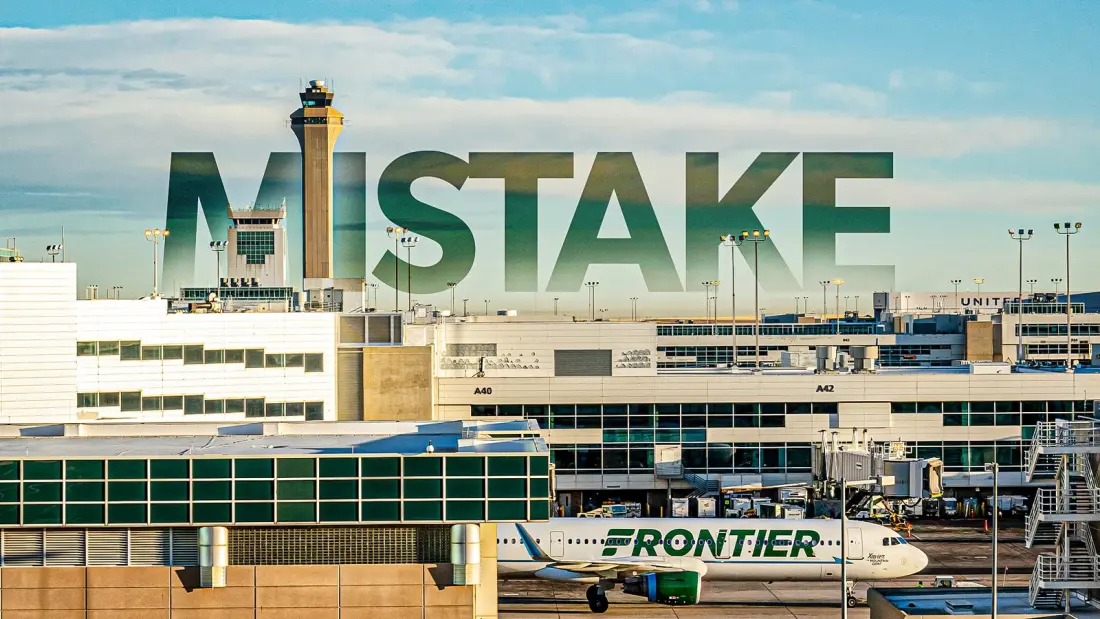
Denver International Airport is now one of the busiest hubs on the planet, handling over 82 million passengers in 2025. But its opening was a disaster, and the culprit was luggage. An ambitious automated baggage system — thousands of radio-controlled carts on roughly 17 miles of track — pushed the airport's debut back 16 months and helped push total costs past $1 billion.
The idea sounded brilliant in the mid-1980s planning phase. Instead of baggage handlers and tugs, around 4,000 destination-coded vehicles would read each bag, work out where it needed to go, and deliver it straight to the right aircraft or carousel. No airport had tried automation at this scale, and Denver committed to it while the airport itself was still under construction on its vast 53-square-mile site northeast of the city.
Reality was less impressive. In testing, carts jammed and derailed, bags were misrouted and crushed, and jams were frequent enough to halt trials altogether. The airport was meant to open in 1993; it finally welcomed passengers on February 28, 1995, after an overnight switch from the old Stapleton airport involving more than 100 aircraft. By then, a conventional baggage system had already been bolted on alongside the automated one.
The bill kept climbing. The often-quoted $560 million overrun covers the delay, but add roughly $250 million for the system itself, $100 million in related construction and $341 million in accumulated interest and you're past a billion dollars. United Airlines, the anchor tenant, was locked into about $60 million a year in lease payments tied to the system it had stopped trusting. It finally pulled the plug in 2005, switching back to bags, carts and people — a move the airline expected to save around $1 million a month, with about $43 million of the old equipment written off.
The lesson has outlived the machinery: automating a messy process doesn't make it simple. Real airports deal with odd-shaped bags, late gate changes and unpredictable passengers, and human judgment absorbs that chaos better than rigid software. For travellers passing through Denver's tented, mountain-inspired terminal today, the story is a footnote — but a useful one, since the airport's huge footprint and six runways gave it decades of room to grow into the giant it is now, with United holding a 50.4% market share.