
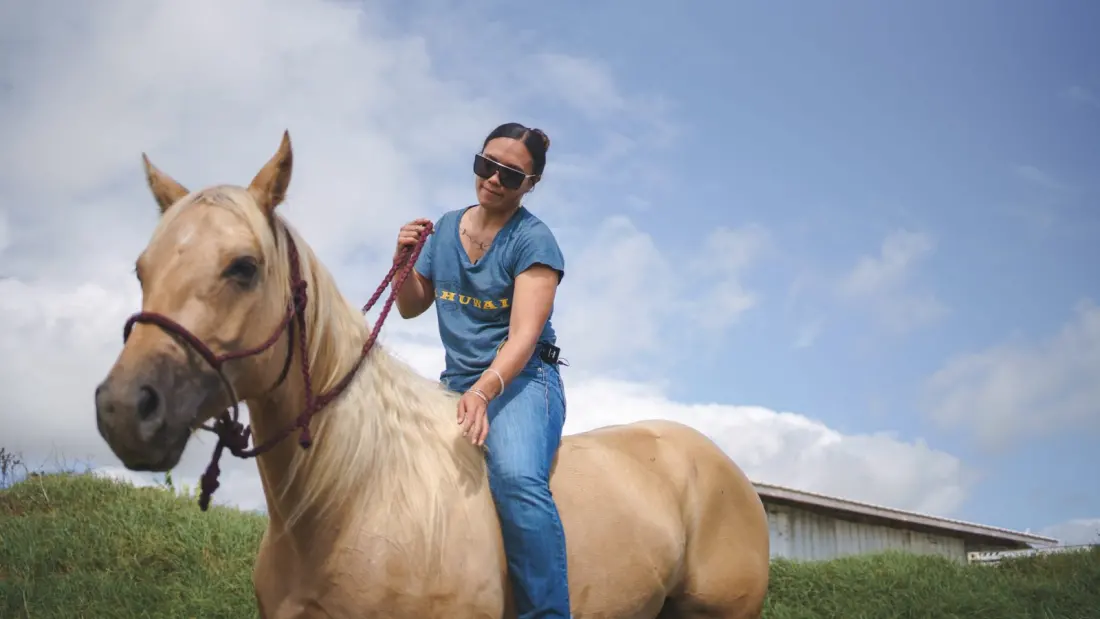
On a homestead outside Waimea on Hawaiʻi island, a young paniolo (Hawaiian cowboy) named Nahe Keakealani starts every day the same way: by watching. Not scrolling, not checking the weather app — standing still and reading the sky, the clouds and the land around her. In Hawaiian, this practice is called kilo, and it is far more than cloud-gazing. As Nahe puts it, kilo and aloha ʻāina — love and care for the land — go hand in glove. To care for a place, you first have to understand how it moves, and to understand it, you have to watch it properly. She treats it almost like prayer time: first thing in the morning, and again throughout the working day. On the morning she demonstrated it, she read the swelling clouds and predicted rain within roughly two hours.
The setting tells you a lot about what makes Waimea different from the postcard version of Hawaiʻi. This is ranching country — green, windswept pastureland on the Big Island's north, where the paniolo tradition stretches back generations, long before the American cowboy became a cultural export. Around Nahe's homestead, the details are endearingly unpolished: an old three-seater couch set out in a field and used for shooting practice (locals call it the gun couch), a horse named Gypsy described as a genuine diva, and her dog Sister, who shadows her every step — stopping when she stops, looking where she looks, so that girl and dog stand silhouetted in the same direction against the Waimea hills.
Nahe's work sits at the meeting point of ranching and conservation. Among the things she points out on the land is a fledgling wiliwili, a deciduous native tree found only on Hawaiʻi island — a small but telling sign of regeneration in a place where native forests have long been under pressure. The profile frames her as part of a Gen Z cohort taking up both the paniolo legacy and the stewardship of the island's remaining native ecosystems, rather than treating the two as opposites.
For travellers, the takeaway is a shift in how you might experience the Big Island. Waimea and the surrounding ranchlands offer a completely different Hawaii from the resorts of Kona or the beaches of the Kohala coast: paniolo country, where the culture on display is one of horsemanship, ranching and a deeply practical relationship with the land. And the idea at the heart of Nahe's story — kilo — is something any visitor can borrow. Slow down, watch the weather actually happen, learn a handful of Hawaiian terms for the landscape around you. It turns a drive through ranch country into something closer to participation than sightseeing, and it is a respectful way in: locals will tell you that observing before acting is the whole point.