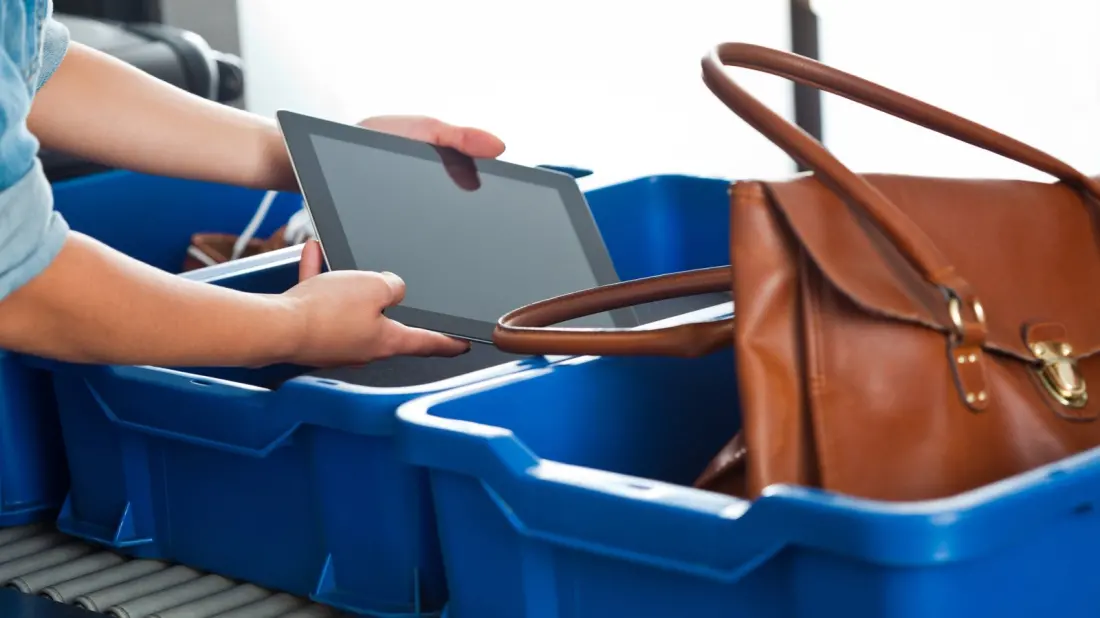
Few airport moments spike anxiety quite like standing at the X-ray belt wondering if you've packed your bag correctly. One of the most common grey areas: does that tablet in its snug protective sleeve count as "removed from your bag," or does the sleeve itself need to go too?
The TSA's guidance is actually clearer than most travellers realise. Any personal electronic device larger than a cell phone — so tablets, e-readers, laptops — must come out of your carry-on and be placed in a bin with nothing on or under it. Read literally, a fitted sleeve sitting on top of the screen fails that test, which is why the safe move is to slip the tablet out of its case before it hits the conveyor. It takes two seconds and guarantees you're compliant no matter where you're flying.
There's a wrinkle, though. Newer CT scanners at a growing number of airports can image bags in 3D, letting passengers leave electronics and even liquids packed as normal. But not every terminal has this kit, and rules at the same airport can differ depending on which checkpoint you land in. If you want certainty before you travel, a quick check of your departure airport's website or security page will tell you whether it runs the newer equipment.
Checked luggage is another dodge: if you can live without your tablet mid-flight, stowing it in your checked bag sidesteps the bin question entirely. Just remember the liquids-in-checked-bags freedom doesn't change the basic rule — devices in carry-ons still need to follow standard screening.
If you skip the research, the checkpoint itself gives you clues. Listen to what agents are telling people ahead of you, read the signage near the belt, and watch whether travellers in front are pulling electronics out. Regular security lines reward pattern-matching; if nobody else is unpacking tablets, your scanner probably doesn't require it. When in doubt, though, just take it out of the sleeve — being the person who holds the line up because of a rescan is far worse than a slightly slower bin-loading routine.
Worth noting for frequent flyers: TSA PreCheck and Clear members generally keep devices and shoes on, which is a big part of why those programmes feel so much calmer. For everyone else, a small pre-flight ritual — empty pockets, tablet out of sleeve, laptop accessible — turns the most stressful part of the airport into something routine. The takeaway for any traveller: the TSA's official line is "nothing on or under the device," so when you're torn between convenience and compliance, the sleeve comes off.