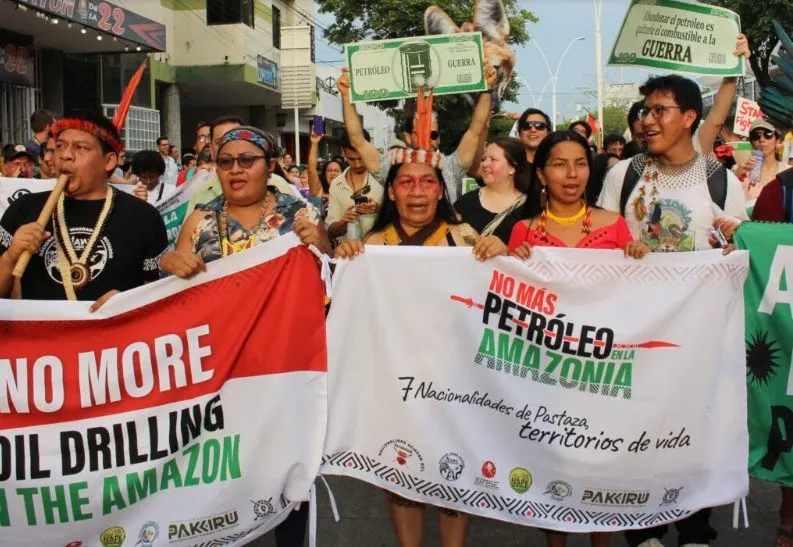
While Ecuador's oil sector gathered in Quito this week for ENAEP 2026, the country's flagship energy summit, a familiar standoff was playing out behind the conference halls. The government is pitching new investment in Amazon oil blocks, but seven Indigenous nations whose territories sit atop those blocks have issued a joint declaration rejecting the projects outright — and warning companies not to get involved.
The proposed auctions, known as Ronda Suroriente and Ronda Subandina, cover 18 blocks across roughly three million hectares of remote, largely roadless rainforest in Ecuador's central and southern Amazon. Although officials announced 2026 as the launch year, neither round has actually opened, with the final quarter of the year underway. It's the latest delay in a decades-long effort by successive governments to open the region to drilling.
History isn't encouraging for investors. A similar push in 2012 — the XI Ronda Petrolera — offered 13 Amazon blocks with heavy international promotion, including roadshows in Houston, Calgary and Paris. Only three blocks drew bids: one from Spain's Repsol, two from China-backed Andes Petroleum. Repsol eventually walked away, Indigenous opposition blocked Andes Petroleum's exploration plans, and both blocks ended up suspended under force majeure. Not a single exploratory well was ever drilled.
Advocacy group Amazon Watch argues the current proposal is essentially the same opportunity repackaged, with the same ground-level opposition intact. Beyond the political risk, environmental groups point to what's at stake: some of the Amazon's most intact forest, a critical carbon sink already near an ecological tipping point. New drilling would bring deforestation, fragmentation and spill risks to territories where communities have repeatedly asserted their right to Free, Prior and Informed Consent.
Indigenous leaders have also taken the fight international. In April, delegates from the seven nations spoke at the first global conference on transitioning away from fossil fuels, held in Santa Marta, Colombia, arguing that new Amazon oil fields clash directly with the global energy transition. In August, the XII Pan-Amazonian Social Forum in Puyo, Ecuador, added calls to leave crude in the ground and legally recognise Amazonian territories as extraction-free zones.
What does this mean for travellers? The Ecuadorian Amazon — reachable from towns like Puyo, Tena and Coca, and gateway to lodges around Yasuní National Park — remains one of the most biodiverse places on Earth, and Indigenous-led community tourism is a growing, low-impact way to experience it. If you're planning a rainforest trip, this story is a useful backdrop: the regions in the crosshairs of the proposed blocks overlap the same territories where community-run lodges and guiding operations offer an economic alternative to extraction. Leaders caution that a delayed auction is not a cancelled one, so the debate over the region's future — and what kind of tourism and development it supports — is far from settled.