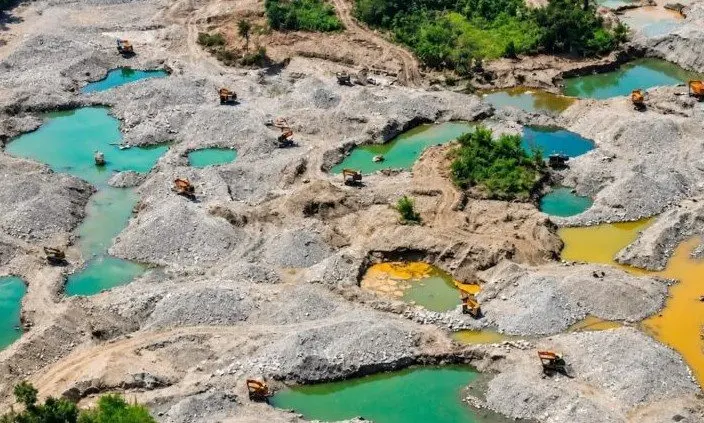
Ecuador's second-most profitable illegal market isn't drugs — it's gold. A report from the Pan American Development Foundation estimates criminal networks earn close to $1.3 billion a year from illicit mining, and the activity has grown sharply since 2020. That matters for travellers who visit the country's Amazon provinces or southern mining towns, because the consequences are showing up on the ground.
The illegal gold economy stretches from the Amazon lowlands to the southern Sierra. Extraction and processing hubs cluster in Orellana, Napo, Zamora Chinchipe, Azuay and El Oro — provinces that include destinations like Zaruma and Portovelo, historic gold towns still popular with independent travellers. The Pan American Development Foundation notes that territorial disputes over mining now resemble those tied to drug trafficking, with some Amazon provinces recording more homicides and extortion complaints.
Behind the mining sits a whole supply chain. Police operations this year broke up an explosives-trafficking ring moving material in from Peru across Imbabura, Carchi, Loja and El Oro, and a joint Ecuador–Peru operation across seven provinces led to 23 arrests, uncovering a route from the Peruvian border to the Colombian one. In July, authorities arrested an alleged Los Lobos member and weapons supplier in Santa Rosa. The gang, according to the Global Initiative Against Transnational Organized Crime, is involved in moving gold to processing plants in Portovelo and Zaruma and on to Guayaquil for export.
The state is pushing back hard. Between January and August, Ecuador's Armed Forces destroyed 1,101 camps and 1,680 mine entrances, disabled hundreds of excavators and dredges, and seized more than 53,000 sacks of gold-bearing material. Prosecutors charged 60 people in a case stemming from illegal mining at Yutzupino in Napo, and the country's financial intelligence unit opened a money laundering probe tied to Los Lobos. Ecuador is also coordinating with Peru, Colombia and Andean neighbours, while US Homeland Security Investigations brought five countries together in Cusco to train units on tracing laundering and cross-border money flows.
Experts caution that destroying camps and machinery only goes so far if the commercialization end stays untouched — that's where the real profit and the money laundering happen. So expect enforcement pressure to continue across the Amazon and the south for the foreseeable future.
Why does this matter if you're planning a trip? Ecuador's headline destinations — Quito, Cuenca, the Galápagos, the Avenue of the Volcanoes — remain outside these conflict zones, and most visits pass without incident. But if your itinerary includes remote Amazon provinces like Napo or Orellana, or the southern mining belt around Portovelo and Zaruma, it's worth checking current government travel advisories and local conditions before you go, avoiding any informal mining areas, and keeping plans flexible. Border zones with Peru and Colombia, where smuggling routes run, deserve extra caution too.
Credit: Cuenca High Life