Missouri's rolling hills and big rivers once supported hundreds of small communities built on mining, timber, steamboats and farming. When the economics shifted, the towns didn't just fade — some were wiped off the map entirely. A new roundup highlights eight of these lost places, and several are genuinely worth building a road trip around.
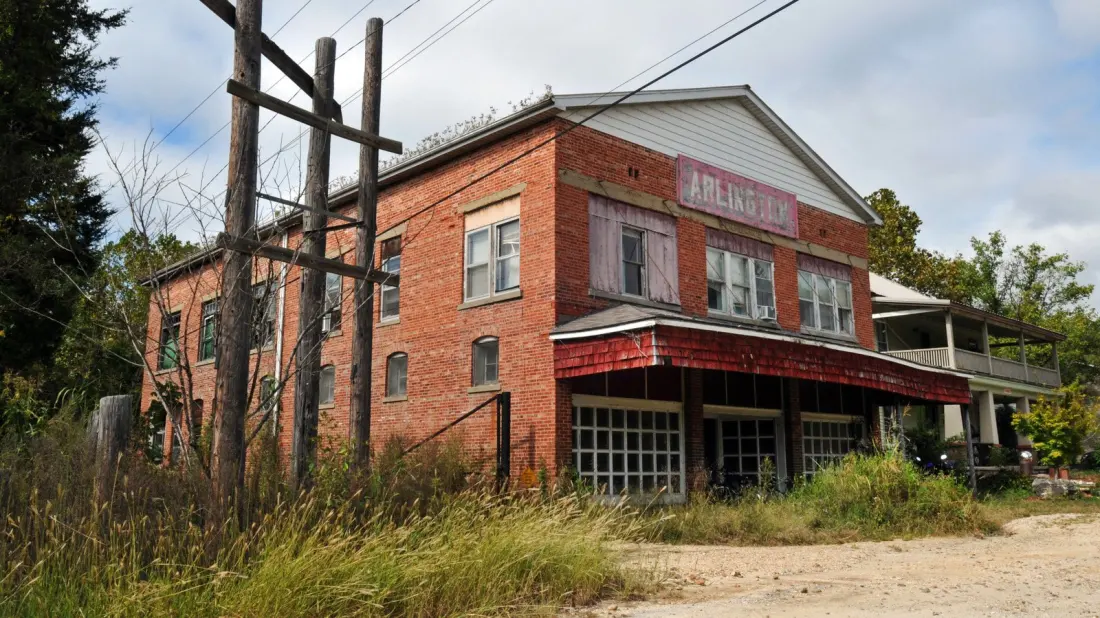
The most atmospheric is Arlington, about two hours from St. Louis. A pioneer settlement that reinvented itself as a Route 66 resort town, it withered when Interstate 44 bypassed the Mother Road. A few derelict resort cabins still sit at the end of a weathered stretch of old pavement in the woods.
Bloodland, south-central Missouri near Springfield, has an odder story: a busy early-1900s farming town with mills, stores and even a tomato-canning factory, emptied in 1941 when the government took the land for Fort Leonard Wood. Its cemetery and a lake survive inside the active military installation — you'll need to pre-register with the U.S. Army to visit.
History runs heavier at Far West, an hour from Kansas City. Settled in 1836 by exiled Latter-day Saints, it briefly swelled to around 5,000 residents and served as church headquarters before militias forced most people out in 1838. It's now on the National Register of Historic Places, with a temple monument holding four original cornerstones from a temple never built.
Floods did for others. Old Greenville, near Poplar Bluff in the southeast, was a timber boomtown on the St. Francis River until high water pushed residents two miles north; the old site now has a mile-long self-guided Memory Lane trail tracing the original sidewalks. Old Pattonsburg, northwest of Kansas City, followed the same script after catastrophic flooding in 1993 — cornfields now cover its street grid. Seventy-Six, on a forested Mississippi bend under two hours from St. Louis, died slowly as steamboat traffic waned; the site is now a conservation area where cottonwoods and trails replace the old general store and streets.
Two more round out the list. Times Beach, just 40 minutes from downtown St. Louis, was a 1920s Route 66 resort ruined by dioxin-tainted waste oil sprayed on its roads; residents were evacuated and buildings incinerated, and the site is now Route 66 State Park, with the old Bridgehead Inn surviving as the visitor center. And Jollification — yes, that's the real name — is a mid-1800s mill village on Capps Creek near Springfield that was largely burned in the Civil War and bypassed by the railroad, leaving a restored water-powered grist mill and a small historical park.
Together they make a compelling case for Missouri as an offbeat weekend-drive destination: the sites cluster loosely around St. Louis, Kansas City and Springfield, most are free to wander, and each pairs easily with state parks, rivers and Route 66 nostalgia already on the route. History buffs, photographers and road-trippers who like their attractions quiet will get the most out of it.