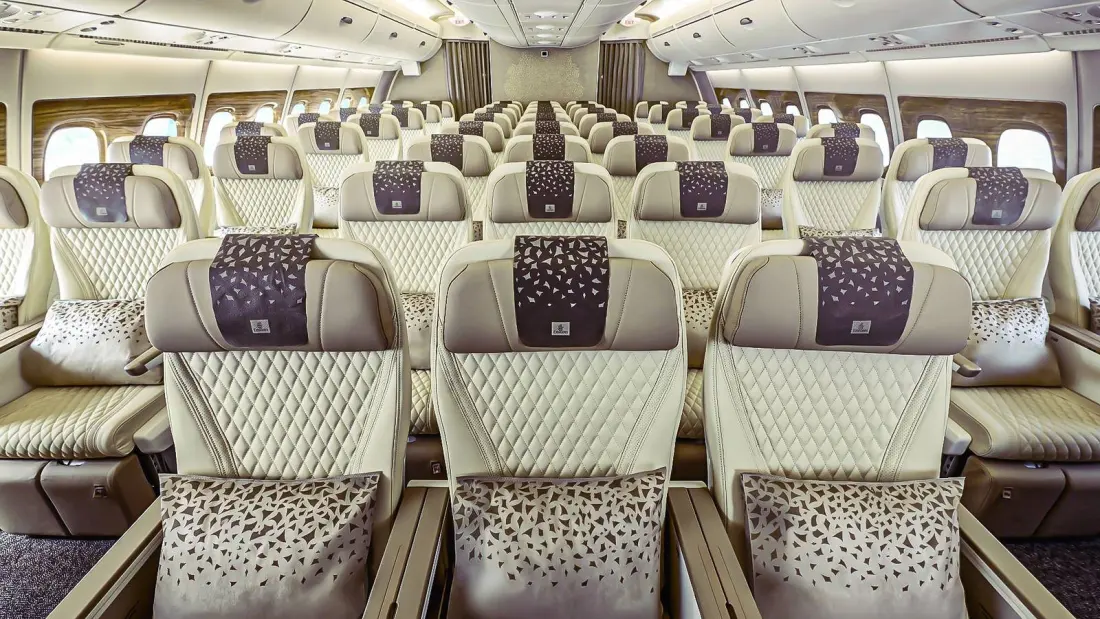
If you're flying between Europe and Dubai, Emirates' premium economy cabin has quietly become the fare class to watch. The airline has been rolling the cabin out across its fleet, and it has become especially popular on Europe routes, where flights typically run five to seven hours — long enough for economy to feel tiring, but arguably too short to justify business class prices.
The rollout is well under way. Emirates has retrofitted more than 50 of its 116 Airbus A380s with premium economy, plus 43 of its Boeing 777-300ERs (with 71 planned) and the entire Boeing 777-200LR fleet. Every new Airbus A350-900 arrives with the cabin fitted as standard. On the A380, the seats sit on the lower deck of most aircraft, but one high-density variant places all 56 premium economy seats on the upper deck — where first class used to be.
Onboard, every cabin uses Recaro PL3530 seats with an above-average 40 inches of pitch, laid out seven-abreast on the A350 and A380 upper deck, and eight-abreast on the 777s and A380 lower deck. The soft product includes a rotating seasonal menu served on chinaware with metal cutlery, access to a wider drinks list featuring select business class wines, and an amenity pouch with skincare basics. Smaller cabins also mean more attentive service than at the back.
Why does this cabin make so much sense on Europe–Dubai specifically? The logic is about flight length. On a six-hour hop, few travellers can really use a lie-flat business class pod, but standard economy can still be draining. Premium economy offers the middle ground: more space and better food without the premium price of a pod. On ultra-long-haul routes to the US or Australia, business class starts to look worth the stretch — but on short European sectors, the middle cabin aligns neatly with what passengers actually want.
There is a catch worth knowing before you book. Emirates tends to price premium economy closer to business class than to economy — often near double the economy fare — so the value proposition depends heavily on the date and route. Supply is limited (the cabins are small, 24 to 56 seats per plane), which keeps fares firm on busy routes, though the airline has discounted on some sectors to stay competitive. If the gap to business class is small on your date, the pod is the better buy; if premium economy is well priced, it's the sweet spot.
For travellers, the practical takeaway is simple: check which aircraft operates your flight before booking. Emirates deliberately schedules premium economy-equipped A380s on its flagship Europe, North America and Asia routes, but the cabin isn't on every plane yet. A quick look at the seat map when booking will tell you straight away whether you're getting the 40-inch Recaro or a standard economy seat. As the retrofit programme continues across the 777-300ER and A380 fleets, more routes will gain the cabin — but for now, it rewards a little booking diligence.