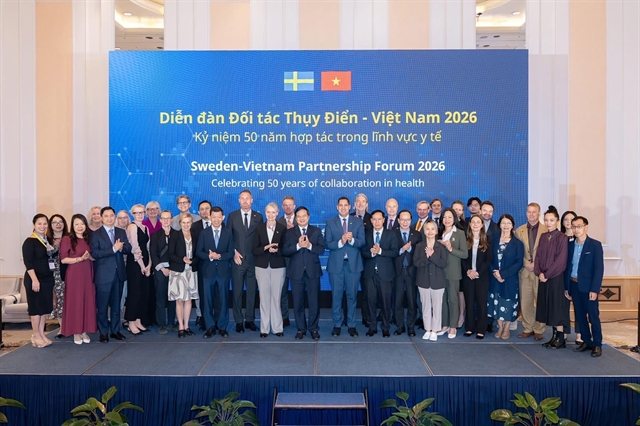
Sweden and Vietnam just marked a big milestone: 50 years of cooperation in healthcare, celebrated during Sweden–Vietnam Health Week 2026, held from 16–18 November and organised by the Embassy of Sweden, Business Sweden and Karolinska Institutet. The backstory is genuinely remarkable. Sweden was the first Western country to establish diplomatic relations with Vietnam, back in 1969 during the war. Health collaboration followed quickly — a joint hospital in Uông Bí, Quảng Ninh in 1976, then a children's hospital in Hà Nội in 1981, which grew into today's Vietnam National Children's Hospital.
The numbers tell the story of transformation. More than 40,000 Vietnamese health workers have been trained with Swedish support, at least 65 Vietnamese doctors have earned PhDs at Karolinska Institutet, and the country itself has changed beyond recognition. GDP per capita now exceeds US$5,000, under-five mortality has dropped from around 51 per 1,000 live births in 1990 to about 17, and life expectancy sits near 75 years. Few countries have improved public health so quickly.
The research partnerships have had global reach, too. University of Gothenburg's cholera vaccine work with Vietnamese institutes from the mid-1980s became the world's first low-cost oral cholera vaccine, WHO-approved in 2011 — a vaccine many travellers to Asia have benefited from. Uppsala University's NeoKIP trial showed community groups could cut newborn deaths, and Swedish-Vietnamese teams built the infection surveillance system now used across Vietnam's Ministry of Health.
What's new is the direction of travel. As Ambassador Johan Ndisi noted, this is no longer a one-way relationship: Sweden contributes digital health tools and quality systems, while Vietnam brings scale, speed and a young workforce. A joint cooperation programme for 2027–2030 was proposed at the Health Week meetings, a new newborn resuscitation simulation centre opened at Hà Nội Obstetrics and Gynaecology Hospital with backing from Getinge's Carl Bennet, and a memorandum of understanding was signed with VNU University of Medicine and Pharmacy.
So why should a traveller care? If you're planning a trip to Vietnam, this half-century of investment means the healthcare landscape is far stronger than most visitors expect. Hanoi and Ho Chi Minh City now have capable international-standard providers — the delegation visited Chợ Rẫy Hospital and Vinmec Central Park in HCM City, and Family Medical Practice, whose medical director wrote this account, runs centres in Hanoi, HCM City and Đà Nẵng with international doctors, 24/7 service and emergency ambulances. For anyone travelling with children, dealing with a chronic condition or simply wanting reassurance in a busy destination, Vietnam's public and private health sectors are a real reason for confidence — and a legacy of a very unusual friendship.