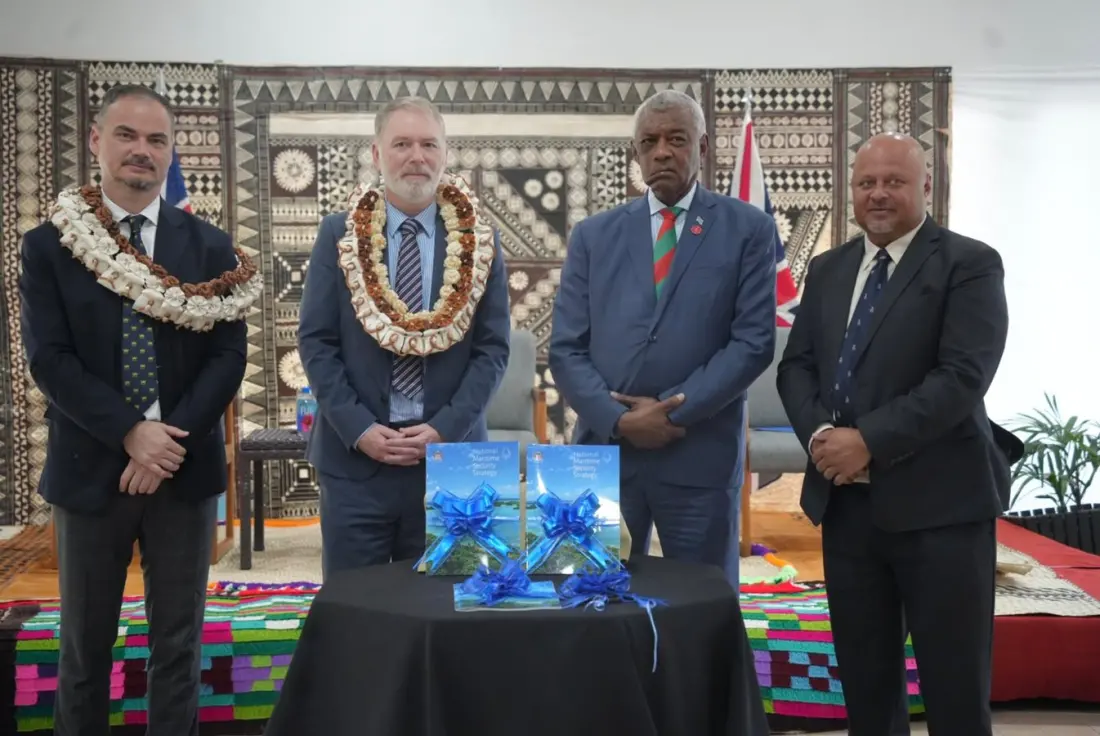
Fiji has formally adopted a National Maritime Security Strategy, the first integrated plan of its kind in the Pacific, designed to close legal loopholes, improve coordination between government agencies and push back against transnational crime at sea. Defence Minister Pio Tikoduadua unveiled it at a launch where he singled out drug trafficking as the most urgent threat facing Fiji and its neighbours.
The scale of the challenge is easy to underestimate. Fiji's maritime zone stretches across more than 1.28 million square kilometres, and over 96 per cent of the country's trade moves by sea. Criminal networks, the minister noted, have grown more sophisticated at exploiting that vastness, gaps between jurisdictions and weak coordination between authorities. His argument was blunt: agencies cannot tackle 21st-century threats with outdated laws and fragmented powers.
The strategy is essentially a coordinating framework. It clarifies the legal authority of the agencies policing Fijian waters, strengthens maritime domain awareness, and will be backed by a new Maritime Powers Act already endorsed by Parliament. Tikoduadua was careful to pair enforcement with accountability, stressing that measures must remain lawful, proportionate and respectful of human rights.
What makes this story more interesting than a typical policy launch is the community dimension. The UNDP, which began working on the strategy with Fiji in 2024, ran practical programmes in Kadavu, Lau, Rotuma, Beqa and Vatulele — some of the country's most remote and most beautiful island communities. Locals received boatmaster licensing, outboard engine maintenance training and fibreglass boat repair skills. The idea is that maritime security is not just about navy patrols; it rests on trust between government and the communities who actually live on and from the water.
The United Kingdom also supported the strategy's development, alongside Fiji's Ministry of Defence and Veterans Affairs. And Fiji is explicit that it cannot secure its waters alone — Pacific security challenges are interconnected, so regional cooperation is treated as essential rather than optional.
Why should travellers care? Ferries, inter-island boats and small-ship cruises are how much of Fiji actually works, and the waters around Kadavu, Beqa and the Lau group are where many visitors head to dive, fish and escape the resorts of Viti Levu. Safer, better-regulated shipping means more reliable island connections and better-trained boat operators — a quiet but real upgrade for anyone planning an island-hopping itinerary. The ocean, as Tikoduadua put it, underpins Fiji's fisheries, tourism, food security and identity; this strategy is the government treating that seriously rather than leaving it to chance. Treat it as background reassurance: the postcard waters are also being looked after.