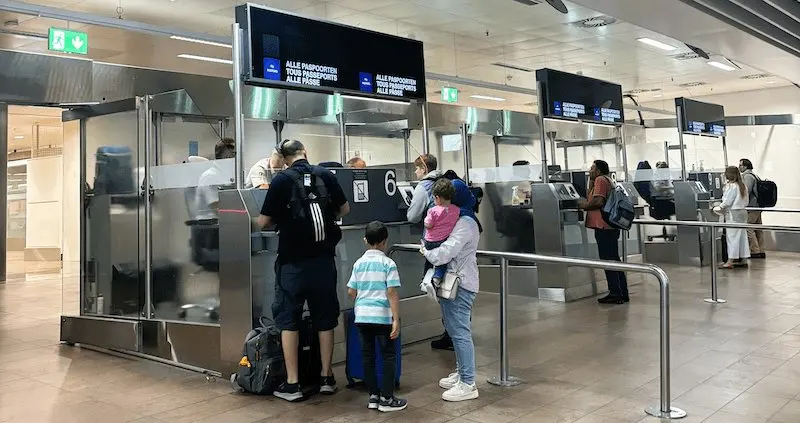
Arrivals at Brussels Airport have been hit by waits of up to five hours at passport control, with non-European travellers bearing the brunt as the EU's Entry/Exit System (EES) runs into repeated technical trouble. The congestion mainly affected passengers flying in from outside the Schengen Area, and a video posted by a Belgian MP in late September showed transfer passengers queuing through the entire terminal, with dozens of families missing connecting flights.
EES is the EU's bid to modernise its external borders. It phased in from October 2025 and became fully operational in April 2026, replacing passport stamps with electronic registration of short-stay non-EU visitors — passport data plus facial images and fingerprints. The goal is to catch overstayers and document fraud more reliably. The reality so far has been slower checks and, at busy moments, chaos.
Brussels Airport did its homework before the system went live. It added 12 extra border booths, fitted 33 with facial-recognition cameras and installed 61 self-service pre-registration kiosks. That hasn't been enough. In February, an e-gate failure forced manual checks and 90-minute waits. By March, queues had stretched to two hours at departures and over three at arrivals, and nearly 600 passengers missed flights in four days. The airport had also lost some flexibility: until April, travellers from certain countries — Americans included — could use kiosks then automated gates. Now they must go through staffed desks, which compounds bottlenecks when several long-haul arrivals land close together.
The industry saw this coming. In February, airport and airline bodies including ACI EUROPE, Airlines for Europe and IATA warned of queues of four hours or more at peak times, citing understaffing, unstable hardware and limited pre-registration. At an EU media briefing in early September, IATA went further, asking for the ability to partially suspend EES procedures when infrastructure can't cope, and listing four essentials: adequate staffing, stable technology, working kiosks and gates, and broader pre-registration. Asked whether warnings of six-hour waits were exaggerated, IATA's Thomas Reynaert said they were not, pointing to extreme cases already seen over the summer.
The pressure is only building. Brussels Airport expected around 5.2 million passengers across July and August, up 4% on the same period in 2025, and the airport says it is working on structural fixes.
For travellers, the takeaway is practical: if you're a non-EU national connecting through or arriving at Brussels, build generous buffer time into your itinerary and consider booking longer minimum connection times than the airline suggests. Expect fingerprinting and facial scans at the border on first entry into the Schengen Area under EES, and keep an eye on your airline's alerts for delay advisories. The system should smooth things out eventually — but almost a year into its rollout, it's still doing the opposite at Europe's busiest border points.