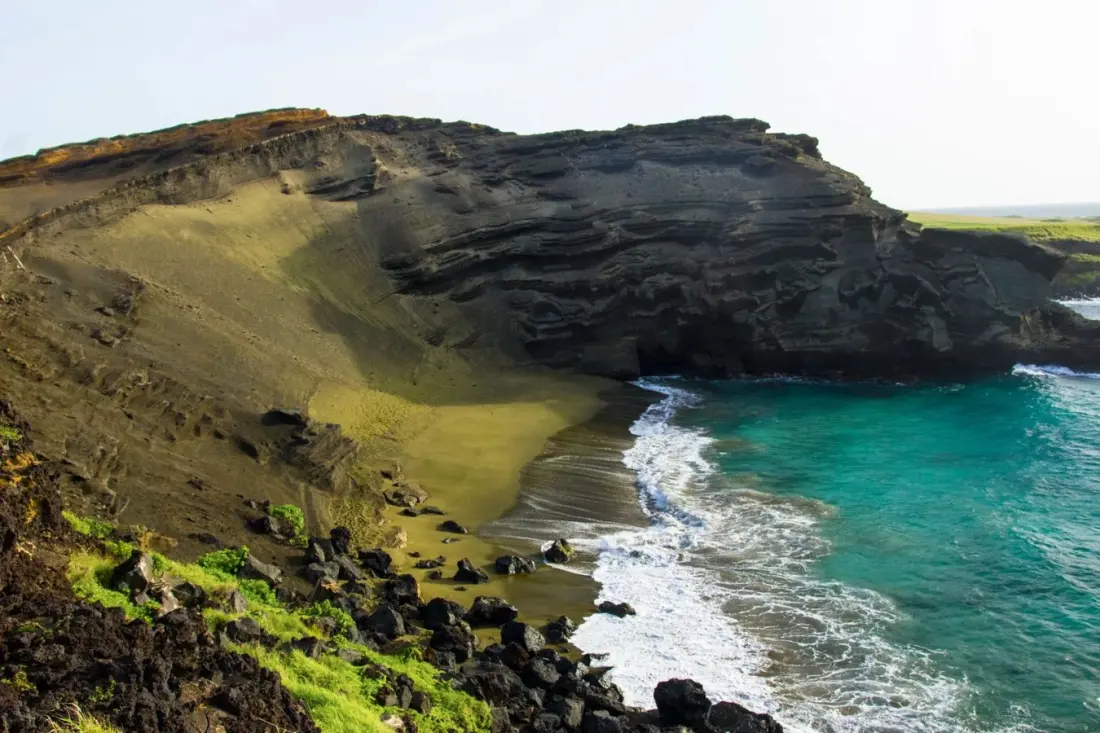
Sand comes in more colours than you'd think — and some beaches don't even bother with sand at all. A roundup of the world's most unusual coastlines serves up everything from a green-sand cove in Hawaiʻi to an Indian beach where the sea retreats up to five kilometres at low tide. Here are the standouts.
South Africa's Boulders Beach, near Simon's Town on the False Bay coast, is one of the few places you can swim within sight of African penguins. The endangered colony took hold in 1983 when a single pair started breeding among the giant granite boulders, and it's now part of Table Mountain National Park. Boardwalks keep visitors off the nesting areas — the birds are wild, so no feeding or touching.
Colour is the draw elsewhere. Papakōlea on Hawaiʻi's Big Island is one of just four green-sand beaches on Earth, its hue courtesy of olivine crystals eroded from the Puʻu Mahana cinder cone. Getting there means a hot, exposed walk over volcanic terrain. Harbour Island in the Bahamas has the opposite problem: Pink Sands Beach runs over three miles, its blush coming from microscopic foraminifera shells ground into the sand — most visible in the wet strip near the water.
Iceland's Reynisfjara is the drama queen of the list, pairing black volcanic sand with basalt columns and the Reynisdrangar sea stacks. It's also genuinely dangerous: sneaker waves surge far up the shore, so stay well back from the waterline. In Santorini, Red Beach near Akrotiri sits beneath iron-rich red and black cliffs, while Milos's Sarakiniko looks so pale and sculpted it's often compared to the Moon.
Some beaches are odd for their geology rather than their palette. Gulpiyuri in Asturias, Spain, is a 40-metre strip of sand in the middle of a green meadow, filled by seawater funnelling through underground limestone channels — high tide brings the sea, low tide nearly empties it. Chandipur in Odisha, India, does something similar on a colossal scale: the sea can pull back as much as 5km, exposing the seabed before roaring back in. Check tide times before wandering out.
Then there are the oddities born of accidents and minutiae. Glass Beach in Fort Bragg, California, was once a rubbish dump until decades of surf polished the discarded bottles into smooth coloured pebbles — which you're not allowed to take home. Australia claims a trio: Shell Beach in Shark Bay, 70km of shoreline made of billions of tiny Hamelin cockle shells; silica-pure Whitehaven in the Whitsundays, whose fine sand stays cool underfoot; and Rainbow Beach in Queensland, backed by cliffs banded in yellow, orange, red and brown. Japan's Kaiji Beach on Taketomi Island hides star-shaped grains — actually the calcareous remains of tiny marine organisms. And Sint Maarten's Maho Beach puts you directly under the flight path of Princess Juliana airport, a thrill best enjoyed without standing in the jet blast.
For anyone bored of ordinary strips of sand, this list doubles as a very good route map — just pack more water, respect the warning signs, and leave the sand where it belongs.