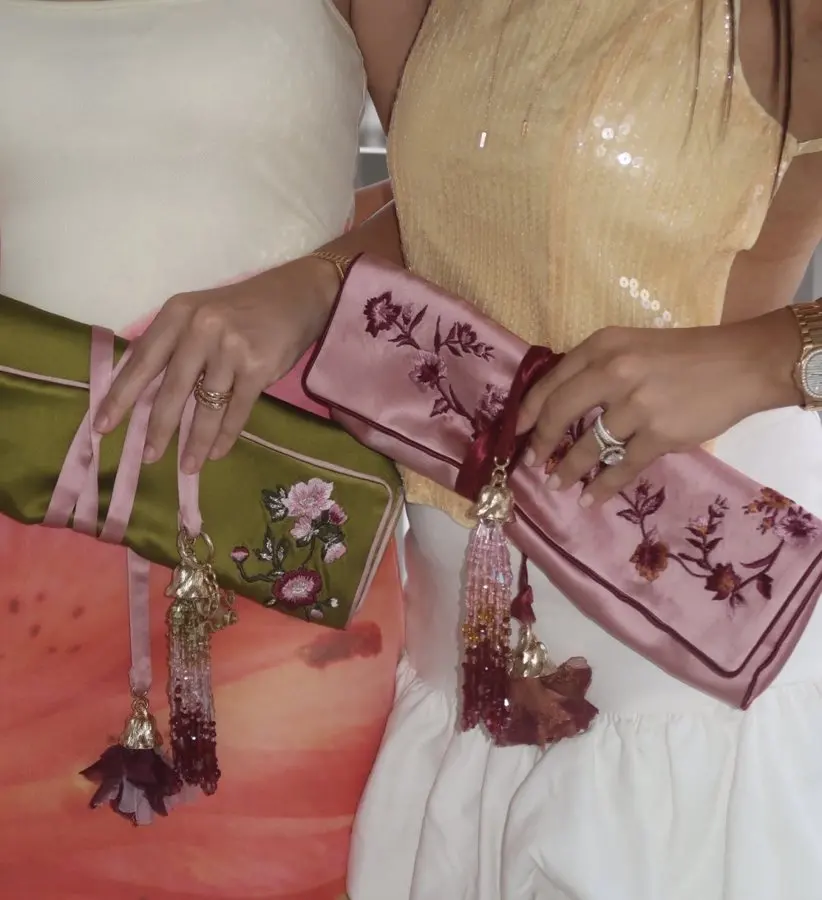
A new luxury handbag label from Cairo is proof that the most evocative travel souvenirs sometimes come stitched, not stamped. Egyptian house Shahira Lasheen launched its debut bag collection in late September, and each piece takes roughly 40 hours of handwork — floral embroidery, satin ribbon details and finishes shaped entirely by artisans in the capital.
The design story is rooted in a very specific kind of Egyptian nostalgia: the traditional home of an Egyptian grandmother. Think floral prints on every surface, gold-plated chairs, ornately patterned boxes — interiors where generations of women expressed elegance and identity through domestic detail. Lasheen has translated that vocabulary into accessories, positioning the bags as couture rather than mere decoration.
The process is deliberately slow and personal. Every bag is made to order, so a client's choice of colours and fabrics shapes the piece from the start, and the artisan's hours of stitching give it further character. "In the end, the bag becomes a meeting point between the woman who chooses it, the story that inspired its design, and the hands that bring it to life," Lasheen told Egyptian Streets.
There's deep history behind the technique. Linen was central to textile production in ancient Egypt, and embroidered fragments linked to Tutankhamun's tomb show how sophisticated the craft was thousands of years ago — running stitch, backstitch and couching were all in the repertoire. Needlework never really left; today Egypt's regional traditions include intricate tambour work heavy with beads and sequins. Lasheen's collection is an attempt to carry that lineage into contemporary design rather than preserve it behind glass.
For travellers, the practical bit: the bags are available to order through the house's atelier in Garden City, a leafy, historic downtown district of Cairo that sits within walking distance of the Nile and Tahrir Square. International orders can be placed remotely through the brand's official channels, so you don't need to be in Egypt to buy one — though visiting the atelier turns the purchase into a genuine cultural experience, complete with a walk through one of Cairo's most atmospheric neighbourhoods.
It's also a useful lens for anyone touring Egypt beyond the pyramids. The country's textile heritage — from linen weaving to the embroidery workshops of old Cairo — is one of its most accessible living crafts, and designers like Lasheen are the contemporary endpoint of that thread. A handmade piece with a documented 40-hour process beats a mass-produced papyrus scroll as a keepsake, and it supports artisans keeping centuries-old techniques alive.