Albania squeezes an extraordinary amount of history into a small country: Greek colonies, Roman arenas, Ottoman mosques, medieval castles and communist-era survivals, often within a few hours' drive of each other. For travellers used to queuing at Europe's big-name ruins, it offers a rare alternative — sites of genuine significance where you might have the place largely to yourself.
The pick of the ancient sites is Butrint, a UNESCO World Heritage Site in the far south and the country's most visited archaeological site. Its remains span around 2,500 years, from Greek settlers in the 5th century BC to the early 19th century. Highlights include a sanctuary to the god of medicine, a vast lower-city defensive wall, the Great Basilica and a Baptistery that was the largest east of Rome. Plan on a full day. Apollonia, founded according to tradition in 588 BC, is quieter and less excavated — roughly 10% of the city has been unearthed — but its museum rewards the trip: expect Greek vases, bronzes, coins and a 4th-century BC shield that took 27 years to reassemble. Allow at least 45 minutes for it.
Near the coast at Durrës stands the Balkans' largest Roman amphitheatre, built in the early 2nd century AD. Elliptical and about 130m long, it once seated around 15,000 spectators — a third of the Colosseum's capacity. Visitors can still descend into the vaults, and one gallery holds 10th- or 11th-century wall mosaics of saints and archangels, the only ones ever found in Albania, dating from when the arena became a Christian burial ground.
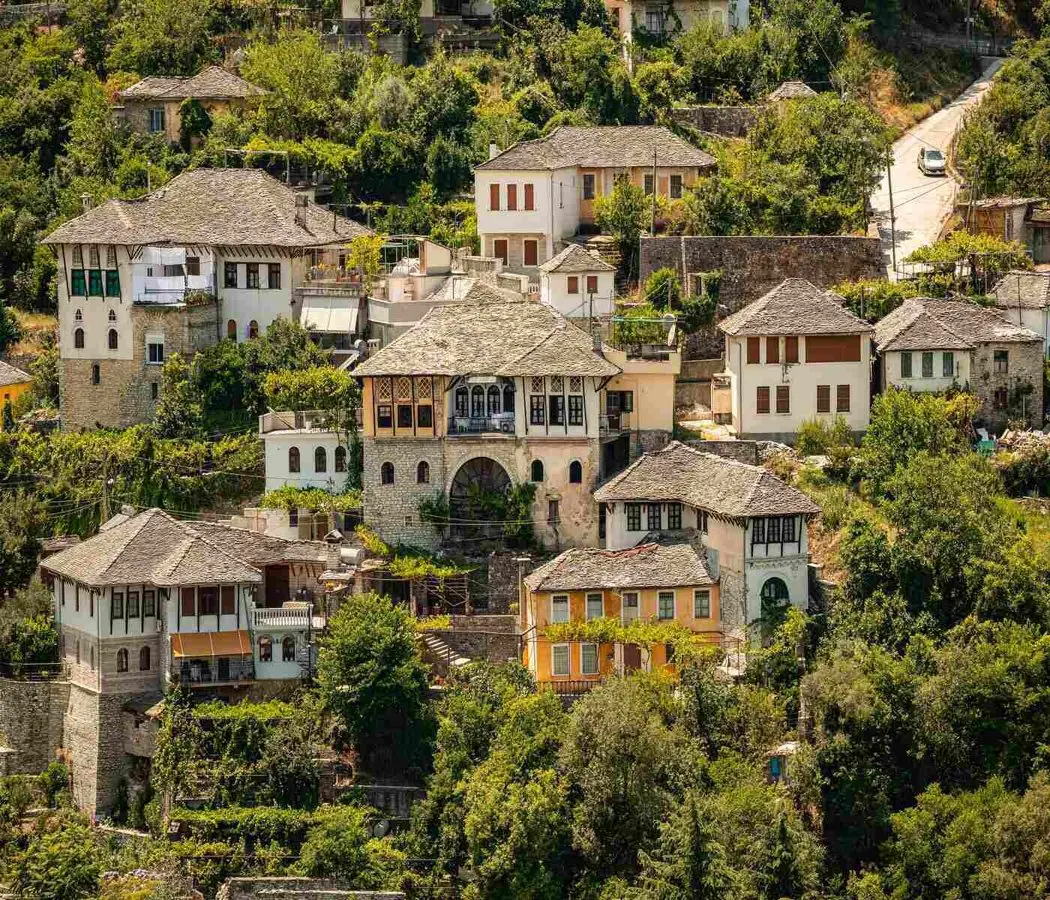
The castle towns add their own chapters. Gjirokastra, UNESCO-listed since 2005, spills downhill from a hilltop fortress that housed a garrison and prison into living memory; it now contains an armaments museum, and among the distinctive 19th-century stone houses the rebuilt home of writer Ismail Kadare is open to visitors. Berati, inhabited for over 4,000 years, stacks white houses up to a citadel holding eight medieval churches — one displaying icons by the 16th-century master Onufri — and two of Albania's oldest mosques. Its 'museum city' status in 1976 saved the centre from communist redevelopment. At Kruja, the castle overlooks the plain towards the Adriatic and contains a 1770 Bektashi teqe, one of the country's oldest, alongside ruins of a 1481 Ottoman mosque.
In the north, Shkodra's Rozafa Castle has been fortified since Illyrian times, when queen Teuta raided Roman shipping from it, and was the last Albanian fortress to fall to the Ottomans. Its citadel looks across Lake Shkodra to Montenegro.
Why it matters: Albania delivers world-class archaeology and layered medieval towns at a fraction of Western European prices and crowds, and it pairs easily with walking, cycling or beach time on the riviera. History-focused travellers and slow explorers will get the most from a two-week loop linking Butrint, Gjirokastra and Berati in the south with Durrës, Kruja and Shkodra further north.