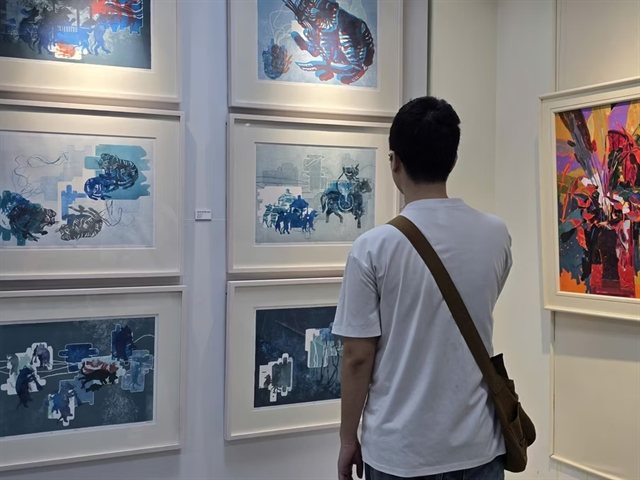
If your trip to Hà Nội skews towards galleries as much as street food, there's a new reason to linger. The second International Fine Arts Exhibition has opened at the National University of Arts Education, gathering 125 selected works from Vietnamese and international artists, lecturers and students under one roof.
The show's theme is a conversation between old and new: traditional materials like lacquer and silk painting sit alongside prints, graphic works, new media experiments and digital art. Organisers describe it as a meeting point for eastern and western traditions, with each piece reflecting an artist's personal identity while contributing to a wider discussion about Vietnamese culture in contemporary art.
One of the more interesting quirks of the exhibition is that lecturers and their students hang side by side. Rector Associate Professor Đào Đăng Phượng says the university deliberately encourages this: teachers who keep their own creative practice teach with more credibility, and early exposure to contemporary art — and to established and international peers in the same room — gives students a head start on professional life. The lineup also includes independent artists and academics from universities, colleges and research institutes, plus the university's postgraduate and doctoral candidates.
Painter Đào Quốc Huy, chairman of the Việt Nam Fine Arts Association, praised young artists for treating traditional materials with fresh eyes, but made a point that resonates beyond academia: with AI now able to generate images in seconds, genuine emotion and lived experience are what give an artwork its value. Materials and technology, he argues, are just tools.
The timing is no accident. The exhibition marks the 56th anniversary of the university's founding on November 7, and it was paired with an international conference on November 6 titled Việt Nam's Art Education Ecosystem in the Digital Age.
For travellers, this is a chance to see the next generation of Vietnamese artists before their prices and profiles climb — university shows like this often reveal talent years before it reaches the commercial galleries of the capital. It also suits anyone curious about lacquer and silk painting, two signature Vietnamese media that are easy to fall for once you see them handled well. Pair a visit with the Vietnam Fine Arts Museum nearby, then browse the small galleries around Tràng Tiền and Hàng Gai streets to trace the same tradition-to-contemporary thread through the city.
Even if you only have a day or two in Hà Nội between other stops, an exhibition like this rewards an unhurried hour: it's compact, free of crowds compared to blockbuster museum shows, and gives you a snapshot of where Vietnamese art is heading, not just where it has been.