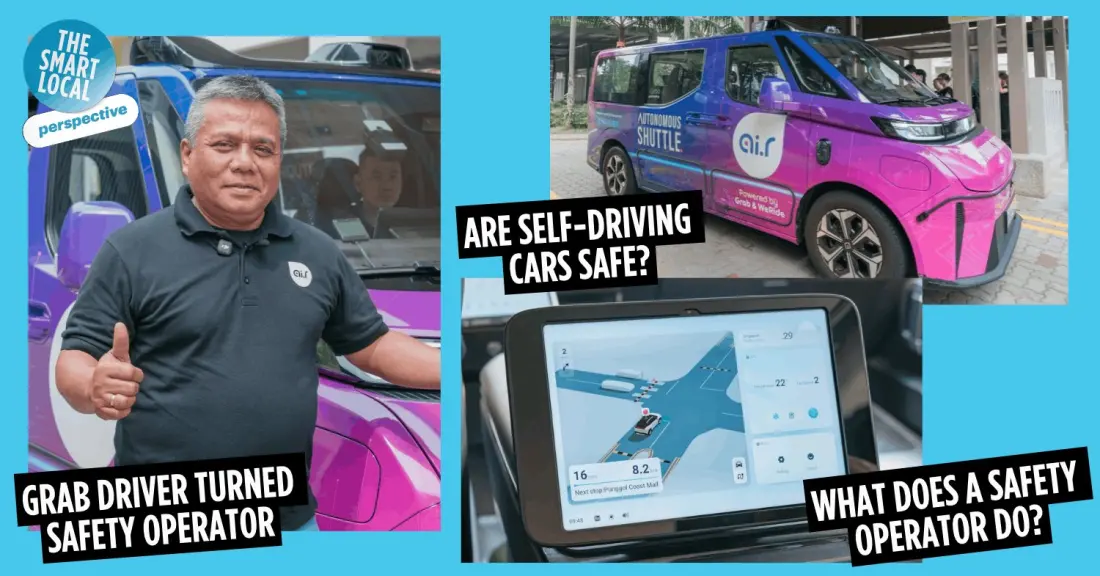
A purple shuttle has been gliding around Punggol since early 2026, and it has no driver doing the driving. Singapore's Community Rides programme put autonomous vehicles into public service in April, with Grab (teamed with WeRide) and ComfortDelGro (with Pony.ai) running fixed routes across the district. Roughly 20,000 people have already ridden, and 99% said they'd recommend it — a figure Transport Minister Jeffrey Siow found almost as remarkable as the tech itself.
So how does the shuttle actually see? Cameras read traffic lights and signs, LiDAR sensors bounce laser pulses to build a live 3D picture of everything around the vehicle, and radar tracks the speed and distance of other cars. AI software pulls it all together to decide when to brake, turn or give way — with no fatigue, phone notifications or road rage in the mix.
Safety checks are layered. Every vehicle has to pass an assessment at CETRAN, NTU's dedicated testing centre, then run thousands of familiarisation trips along its route before carrying passengers. On board, a human Autonomous Safety Operator sits in the driver's seat, monitoring the road and ready to take over via steering, braking or acceleration. Operators like Azman Bin Rahman — a former private-hire driver who retrained in a two-month GrabAcademy and WeRide course — also run pre-shift checks on sensors, screens and manual override systems. The numbers so far back the caution: over 160,000km clocked with zero major accidents, though only on fixed routes for now.
The rollout is expanding fast. ComfortDelGro and Pony.ai added north-eastern Punggol routes in June 2026, point-to-point trips (including to Sengkang General Hospital) are coming, and Tampines North and Tengah are next in line. Waymo plans a driverless ride-hailing launch in 2028, starting with testing around Labrador and HarbourFront. The fleet should grow from 16 vehicles to several hundred within two years, and the industry is creating new roles — with training subsidies covering up to 90% of salaries for taxi and private-hire drivers transitioning in.
Why does this matter to visitors? If you're heading to Singapore's north-east, Punggol is now one of the few places on earth where you can hail a genuinely autonomous ride as part of everyday life. It's a free, easy taste of the future between the waterfront and the HDB heartland — and a good reason to add the district to your itinerary beyond the usual Marina Bay circuit.
First-timer nerves don't seem to last. Even Minister Siow admitted he watched the car's every move on his first driverless ride in 2025; by his second, he was chatting away like it was any other trip. The shuttles aren't meant to replace the MRT or buses — they're filling in first- and last-mile gaps. Fully driverless operation is the next chapter, with safety operators likely shifting to remote monitoring roles. For now, a human is still up front, happy to talk you through exactly what the car is doing.