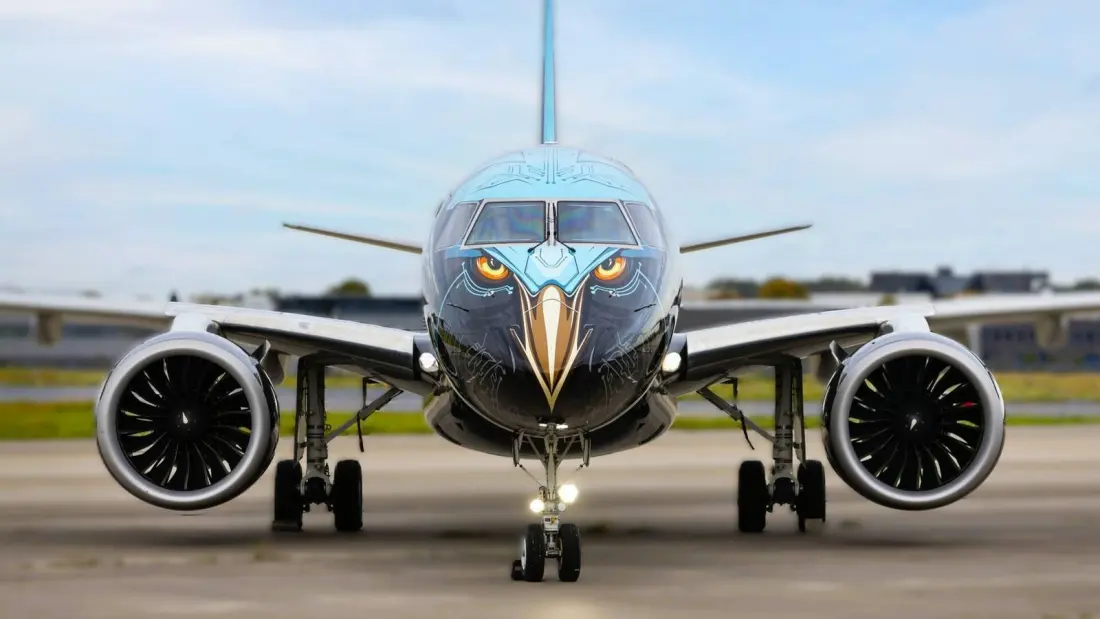
Ever wondered what your regional jet gets per gallon? New analysis of the Embraer E195-E2 puts the aircraft itself at roughly 0.77 miles per gallon — but per passenger, the numbers look far more familiar. Depending on how an airline configures the cabin, each traveller effectively gets between 92 and 112 MPG, which puts the Brazilian jet right up there with the best modern single-aisle aircraft.
The maths works like this: the E2 can carry about 4,505 gallons of fuel and flies around 3,450 miles on a full tank. In a high-density, single-class layout with 146 seats, that works out to 112 MPG per passenger. A roomier 120-seat, three-class setup drops that to 92 MPG — still respectable, and notably better than its main 2-2 rival, the Airbus A220-100, which manages around 77 MPG per seat. For comparison, a Boeing 787-9 widebody gets about 76 MPG per seat despite its size.
Much of the credit goes to Pratt & Whitney's geared turbofan engine, which lets the front fan and core turbine spin at different speeds for better efficiency and lower noise. Fitting that 73-inch fan onto a slim regional jet wasn't easy — Embraer had to redesign the wing, landing gear and stabiliser, eventually settling on distinctive gull-shaped wings that raise the engines without adding heavy landing gear. Combined with fly-by-wire controls and lighter structures, the powerplant delivers a claimed 16% efficiency gain over comparable regional jet engines.
The efficiency story also has an environmental angle. Embraer says swapping an E2 for an older regional jet saves around 56,000 tons of CO2 a year — the equivalent of 93,000 people giving up their cars. Right-sizing flights onto smaller jets instead of oversized airliners can cut emissions by 30%, the manufacturer claims. There is a caveat: the same geared turbofan family has been hit by a powder metal defect that grounded hundreds of aircraft worldwide at its peak in 2024, including a meaningful number of E2s.
For travellers, the practical upshot is simple: if you spot an E195-E2 on your short-haul or regional booking, you're likely getting a quieter cabin (all seats are 2-2, so no middle seats), decent range of up to 3,000 nautical miles, and a smaller environmental footprint than the older regional jets it replaces. Ongoing upgrades since entry into service have shaved a further 2.5% off fuel burn and extended the jet's range by 400 nautical miles. Aviation nerds and eco-conscious flyers alike have reasons to be glad this type is increasingly showing up on route maps across Europe, the Americas and Asia.