London's Strand hides a genuine world first that most passers-by walk straight past. The Savoy Theatre, the West End playhouse attached to the Savoy Hotel, was the first public building anywhere to be lit entirely by electricity — a milestone it reached back in 1881, when impresario Richard D'Oyly Carte opened the venue to stage Gilbert and Sullivan operas.
The system was designed by engineer Sir William Siemens, using Joseph Swan's newly patented incandescent lamps. Around 1,200 bulbs lit the auditorium at a time when gas lighting was the norm — and genuinely dangerous in crowded theatres, with fires a constant risk. The electric lights were quieter, cooler and far safer, and the press of the day marvelled at a theatre you could sit in without the smell and heat of gas. To make the point publicly, the Savoy also ran exterior electric lighting, an early taste of the kind of illumination that would eventually give the Strand its famous festive glow.
That link between the Savoy and electric light has never really been broken. The theatre was rebuilt in 1929 by T. and E. Tildesley in a lavishly theatrical Art Deco style, restored again after a major fire in 1990, and reopened in 1993. It remains a working West End venue today, hosting long-running musicals and plays just steps from Covent Garden and the Thames Embankment.
The Strand itself carries on the tradition each winter, when the street's Christmas lights are switched on in one of central London's most reliable seasonal rituals — one of the first major festive switch-ons of the London calendar, usually in early November. Combine the two and you get a neat little London outing: a show at the theatre that invented electric theatre lighting, followed by a walk down a street strung with thousands of bulbs.
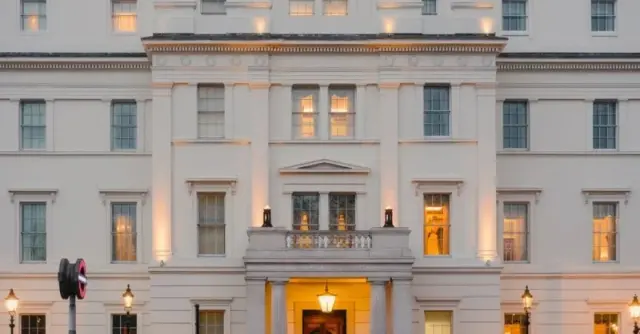
For visitors, the Savoy is easy to fold into a day out. It sits between Trafalgar Square and Covent Garden, close to Somerset House and the river. Even if you don't have tickets, the facade and the surrounding Savoy Court — with its quirky right-hand traffic lane and Art Deco details — are worth a pause. And a matinee followed by the switch-on season lights along the Strand makes for a genuinely historic evening out: the same idea that stunned theatregoers in 1881, repackaged as Christmas sparkle.
Why it matters: this is one of those stories that turns a familiar West End stroll into something more interesting. If you're in London during the festive season, you're walking past the birthplace of public electric lighting — and you can still go inside and see a show under the lights.