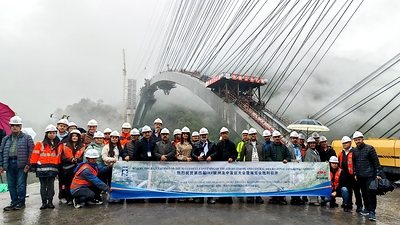
A 437-metre arch bridge is rising over a deep valley in the Caucasus Mountains, and it just pulled a crowd of international road engineers away from their conference in Tbilisi for a site visit.
From 30 September to 2 October 2026, Tbilisi hosted the 4th International Road Federation (IRF) Europe and Central Asia Regional Congress. On the final day, Georgia's Roads Department took delegates three hours north to the Kvesheti–Kobi section of the North–South Corridor Highway, where China Railway 23rd Bureau Group is building the B3 Arch Bridge — the most technically demanding piece of the entire route.
The numbers explain the attention. The bridge stretches 437.875 metres in total, with a main arch spanning 286 metres across the valley. The deck sits 164 metres above the valley floor. Crews are working in genuinely brutal conditions: winds reaching Beaufort scale 9, winter temperatures of -20°C, snow drifts up to two metres deep, and a high-seismic zone underneath it all. The structure itself is a deck-type reinforced concrete twin-rib box arch, built with a cantilever casting method using cable-stayed anchoring. Once finished, it will be the largest-span reinforced concrete arch bridge in the Caucasus, and its span ranks among the world's best for cantilever-cast arch bridges of this type.
During the visit, the project team walked delegates through its methods: European technical standards, FIDIC contract management, high-precision closure control for the twin-rib arch, intelligent monitoring and wind tunnel testing. The delegation examined the arch ring, anchoring and cable hooping systems, and quizzed engineers on winter construction safety and long-term maintenance. Project manager Han Shuai confirmed the team is aiming to close the main arch in 2026.
For Georgia, the bridge is the centrepiece of the North–South Corridor, a national strategy project meant to cement the country's role as the transit link between Europe and Central Asia. For travellers, the payoff is real too: the Kvesheti–Kobi section will eventually replace a stretch of the old Georgian Military Highway — the dramatic mountain road between Tbilisi and the Russian border that currently funnels all traffic through narrow switchbacks near Gudauri. A faster, safer crossing means easier drives to Kazbegi (Stepantsminda), ski trips to Gudauri, and overland journeys between the Caucasus and Central Asia.
Until the road opens, the old Military Highway remains one of the world's great scenic drives, and the construction site itself — tucked into a gorge north of the Ananuri fortress — is a reminder of how much engineering it takes to tame this terrain. Anyone driving the route in the next couple of years can watch one of the region's biggest infrastructure projects take shape in real time. The piece draws on reporting by Laotian Times.