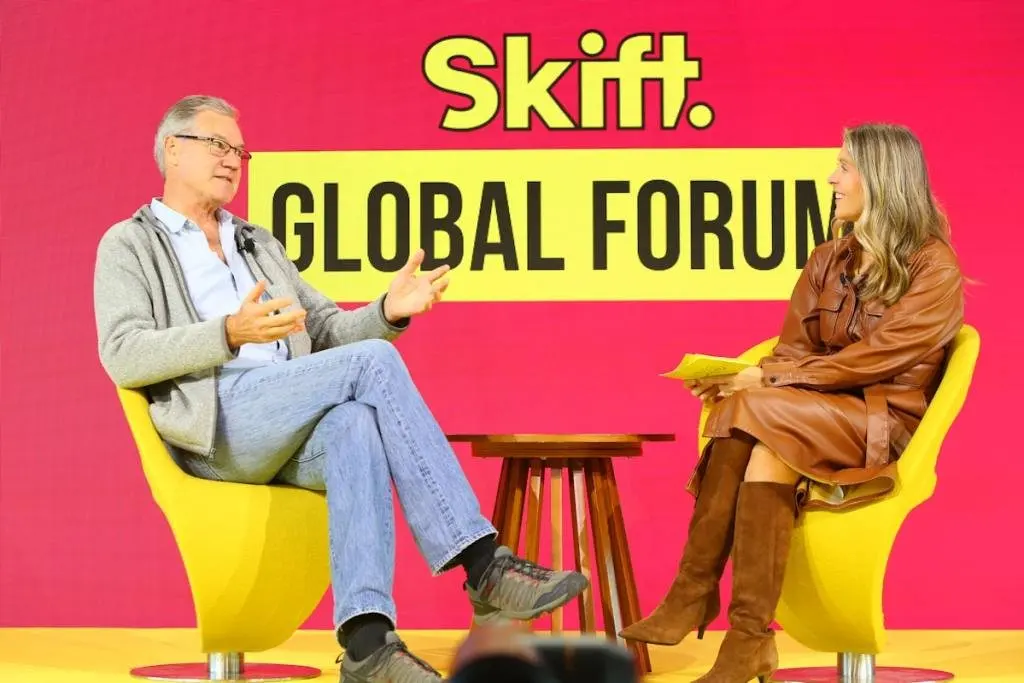
Most travel companies measure the emissions they directly control: the hotels, the vehicles, the offices. Darrell Wade, co-founder and chairman of Intrepid Travel, told the Skift Global Forum that his company deliberately drew a much bigger circle. Intrepid now counts the 'cradle to grave' footprint of every trip, including the long-haul flight the customer books separately just to reach the starting point — even though science-based target frameworks don't require it, since Intrepid never sells those flights.
That accounting choice has real consequences for the product. Intrepid has committed to cutting emissions 8% per passenger per day by 2030, and Wade said hitting that number means redesigning trips rather than just buying offsets. One practical result: building more itineraries closer to major source markets. An American traveller might be steered toward Mexico instead of Morocco, because the shorter flight changes the whole trip's carbon maths. Which trips get sold, and where, becomes a climate decision.
Wade also argued that decarbonisation shouldn't hide in a sustainability report. Intrepid runs a carbon fund that spends money where guests can actually see it working — electric vehicles on the ground in Africa, solar panels installed at remote camps. His view is that travellers want proof on the ground, not theory in a brochure.
On the perennial question of whether sustainable travel costs more, Wade pushed back. Reframing 'will customers pay more' as 'do people want a planet their children can live on', he claimed the correlation between price and carbon efficiency is weak — meaning greener trips aren't automatically pricier ones. He acknowledged the US political climate has set the sustainability agenda back, calling it 'disappointing', but said three decades of this approach has coincided with growth: the more Intrepid invests in communities, staff and planet, the more it grows.
There was an unexpected twist on AI, too. Intrepid has deployed it across 19 workflow areas, yet Wade said it barely changes the core business, because Intrepid is a last-mile operator. The more people plan and book digitally, the more they crave a genuine, in-person experience once they arrive — which, he suggested, puts small-group operators in a strong position as AI spreads.
For travellers, the takeaway is about how to read the sustainability claims of any tour operator. Ask whether emissions include the flights to and from the trip, whether carbon spending is visible in the itinerary, and whether the company is quietly nudging itineraries toward lower-carbon destinations. Intrepid is setting a bar that makes those questions easy to ask. Source: Skift.