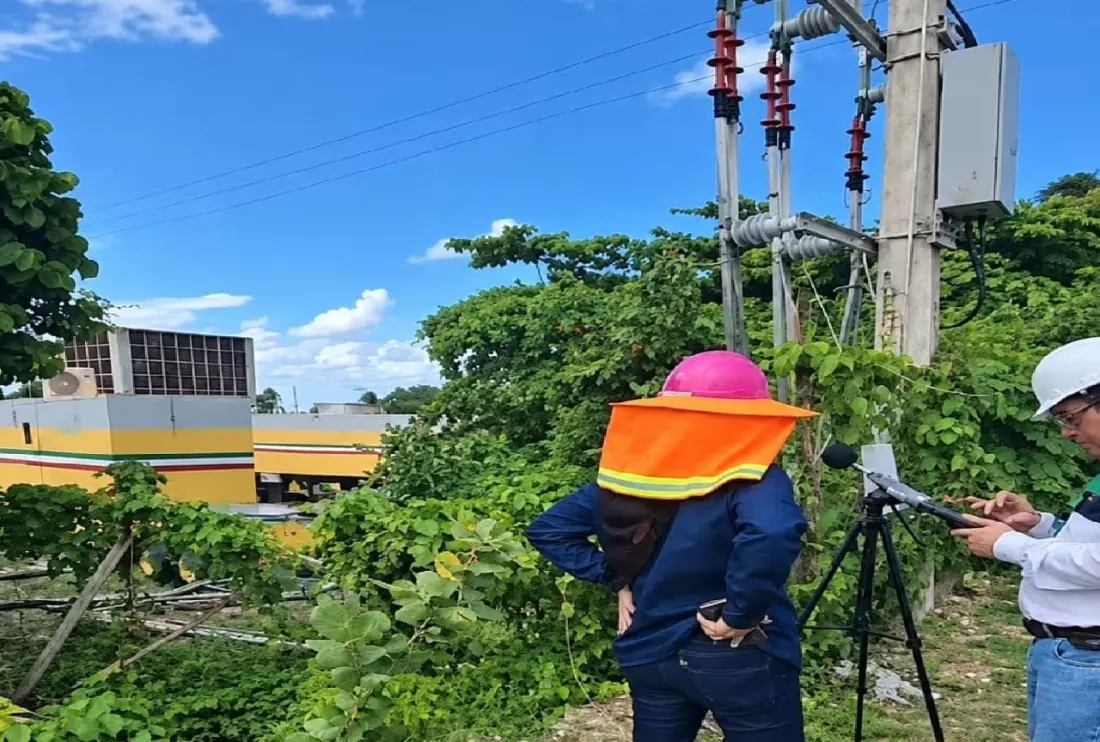
If you've visited Isla Mujeres in the evening and wondered about the low industrial hum rolling across the island, there's now an official answer. Mexico's Federal Electricity Commission (CFE) measured its own portable generator this month and recorded 103.7 decibels — dramatically above the municipal limit of 60 dB. For context, that's closer to a chainsaw than a background hum.
The story behind that number stretches back to 2019, when the diesel generator was set up on the island's old airport as a temporary fix for an overloaded power supply. It was meant to run only until a new submarine cable from Cancun was installed. Nearly seven years later, it's still there, firing up most evenings between 5 and 6 p.m. and running nonstop until 4 or 5 in the morning.
Longtime resident Regina Allende, who has led the push for action, says the first formal complaints went to CFE, environmental regulators and local authorities back in 2019 — the same year the unit was installed. Along with the noise, neighbours have reported diesel fumes whenever the plant is running. Hundreds of complaints later, nothing changed until this weekend's measurements, which confirmed the machine far exceeds legal noise limits under Mexico's environmental standard NOM-081-SEMARNAT-1994.
The response now under discussion is relocation. Officials are studying a move to the southern end of the island, where existing infrastructure could be soundproofed. Mayor Atenea Gómez Ricalde says her administration is tracking CFE's wider maintenance work, which includes replacing poles corroded by salt air and renewing transformers and hardware across the grid.
For travellers, the practical impact is limited — the island's power supply stays on, and nobody is suggesting cutting service. But if you're booking a hotel near the old airport or the western shore, it's worth knowing that evenings in that zone have come with generator noise and diesel smell. With a possible relocation and soundproofing on the table, the island's nights could get noticeably quieter in the near future.
It's also a reminder of the infrastructure strain behind Isla Mujeres' postcard image: a small island heavily dependent on a cable link to the mainland, where demand has outgrown the supply. Anyone planning a stay during peak season — when the island is at its busiest — is essentially part of that demand curve. The grid upgrades underway suggest improvements are coming, just slowly.