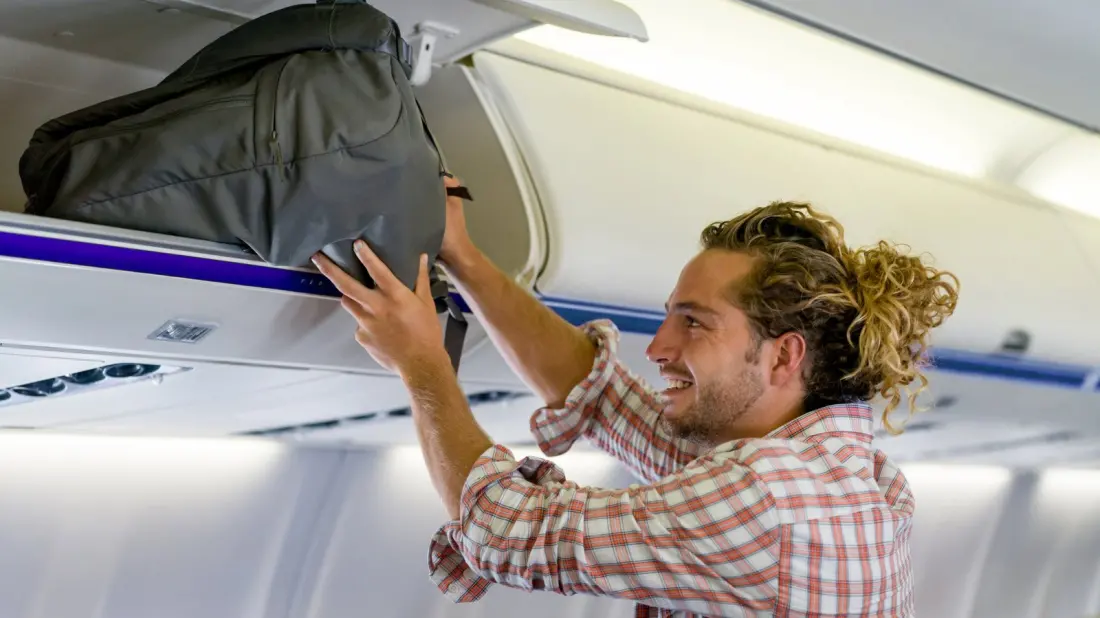
Australia's Jetstar Airways is about to change what a carry-on means. From 2 February 2027, the Melbourne-based budget carrier will only guarantee passengers a small bag that fits under the seat. Anything bigger — the kind of roller bag that normally goes in the overhead locker — will cost extra under a new option called Priority Carry-on.
The numbers are worth knowing. Every passenger, on every fare type, gets one underseat item no larger than 40 x 30 x 20 cm — think laptop bag or small backpack. The current flat 7 kg limit across all carry-ons disappears, replaced by a 10 kg limit per bag. If you want overhead space, Priority Carry-on adds a second bag (max 56 x 36 x 23 cm) plus priority boarding, starting at about 25 AUD ($18) one-way and climbing to roughly 52 AUD ($36) on some routes.
Jetstar frames it as a fix for the most stressful part of flying: the scramble for locker space. CEO Stephanie Tully says the system should make better use of overhead bins, speed up boarding and improve on-time performance, with passengers paying only for what they actually need. It's a fair point in theory — anyone who's watched boarding stall while bins overflow will see the logic. But there's a catch that should make travellers cautious: if your paid carry-on turns out to be over the size or weight limits and has to be checked, Jetstar won't refund the fee, barring what Australian Consumer Law requires.
The airline flies to more than 85 destinations across Australia, New Zealand, Asia and the Pacific Islands, and has historically ranked among the world's better-rated low-cost carriers. This move — following a familiar playbook of unbundling everything — may test that reputation. At what point does a cheap fare stop being cheap once bags, seats and boarding are all priced separately?
For travellers, the practical takeaway is to re-run the maths before booking Jetstar from 2027. If you can travel with a small soft bag under the seat, the base fare stays genuinely low. If you need a proper carry-on, add the Priority Carry-on fee at booking time and compare the total against full-service competitors — on longer routes, the gap may be smaller than it looks. And measure your bag honestly: an oversized roller could end up gate-checked at your own expense.
Who this matters for: anyone flying Jetstar or weighing budget carriers in the Australia-Pacific region, and honestly anyone tracking where low-cost airline fees are heading next. If the model sticks, expect other carriers to watch closely.