Edinburgh Castle and Loch Ness get the crowds. But Scotland's most rewarding historic sites often sit far from the tour buses — a rotating boat lift in Falkirk, a mysterious stone circle on Lewis, a mill town that gave the world a pattern. Bradt Guides has rounded up five overlooked places worth building a trip around.
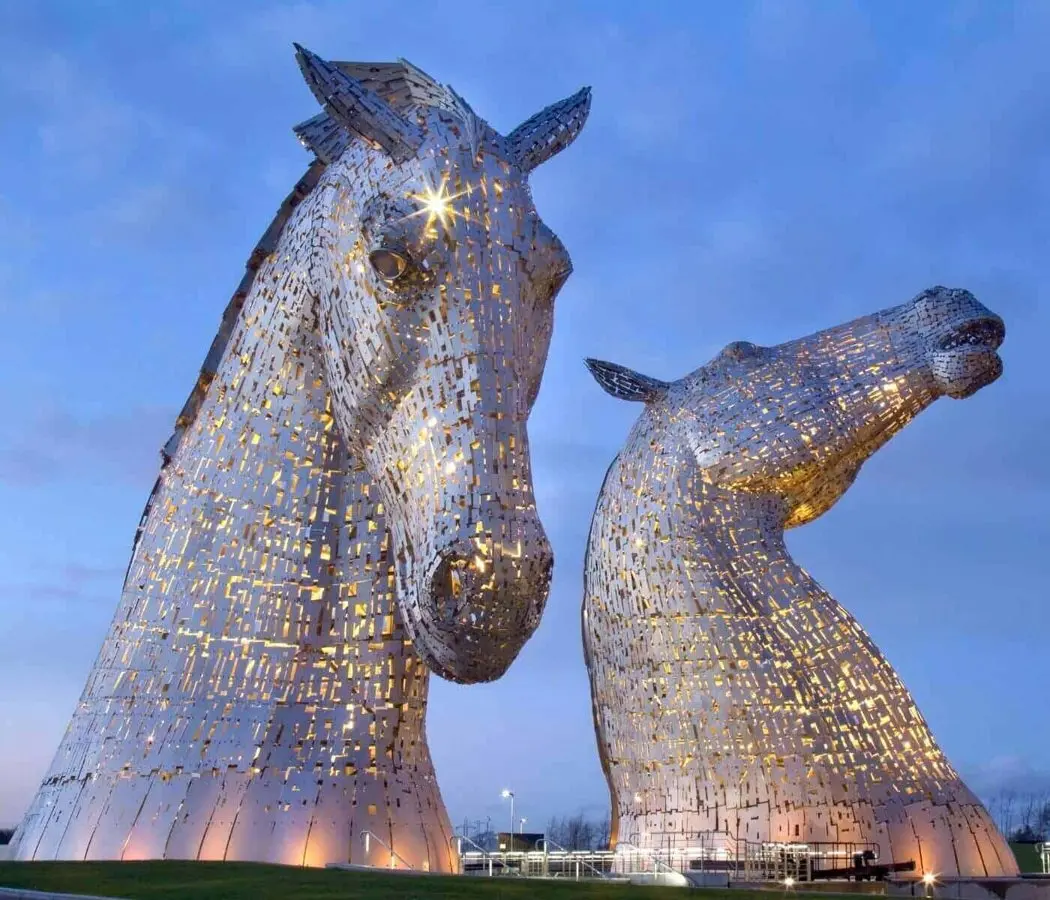
Falkirk, between Glasgow and Edinburgh, was an industrial powerhouse: Scotland's first large-scale factory, two coast-linking canals and the country's first intercity railway all passed through. Today the star attraction is the Falkirk Wheel, the world's only rotating boat lift, which reconnects the Forth & Clyde and Union canals. A boat ride through it is slow and surreal, with sweeping views on a clear day. Two miles away at Helix Park stand The Kelpies — two 98ft stainless steel horse heads weighing 300 tonnes each, built from 928 unique plates and honouring the Clydesdale horses that once hauled canal barges. Falkirk is also, fittingly, the 1875 birthplace of Irn-Bru.
On the Angus coast, Arbroath Abbey is where Scotland's barons drafted the Declaration of Arbroath in 1320, the letter to the Pope asserting Scottish independence — its 'freedom alone' passage still resonates. A mile north, the small museum at St Vigeans holds more than 30 carved Pictish stones, including a cross-slab blending a Christian Last Supper with a pre-Christian fertility ritual.
Head to Caithness, Scotland's far north, and the landscapes feel ancient. The Grey Cairns of Camster, around 5,000 years old, are among the country's oldest stone monuments, reached through the eerie vastness of the Flow Country peatland — which stores roughly 400 million tons of carbon, more than double all of Britain's woodlands. In Castletown, a Flagstone Trail traces the industry that exported Caithness stone worldwide, and the heritage centre displays the engine of a Hurricane fighter that crashed nearby in 1941; its Norwegian pilot survived and ended up in Stalag Luft III.
The island of Lewis packs several eras into one coastline. The Calanais stone circles, raised by farmers who began working the land around 3,500BC, remain unexplained but unmistakably ceremonial. Nearby, Dun Carloway is a well-preserved Iron Age broch — a drystone tower unique to Scotland — while Geàrrannan Blackhouse Village preserves thatch-roofed homes whose peat fires had no chimney; the last residents left only in the 1970s. The Lewis chessmen, relics of the Viking age, appear in local museums.
Finally, Paisley, seven miles west of Glasgow, built its fortune on weaving — including the teardrop pattern that still carries its name. Sma' Shot Cottages preserve an 18th-century hand-weaver's home, complete with the original looms and a caged linnet for company, while the Thread Mill Museum charts the rise of J&P Coats.
These five suit travellers who like their history hands-on and their crowds thin — though some sites are seasonal or need planning, especially on Lewis and in Caithness. Pairing Falkirk and Paisley makes an easy city-based trip; Arbroath, Caithness and Lewis reward the slower road trip.