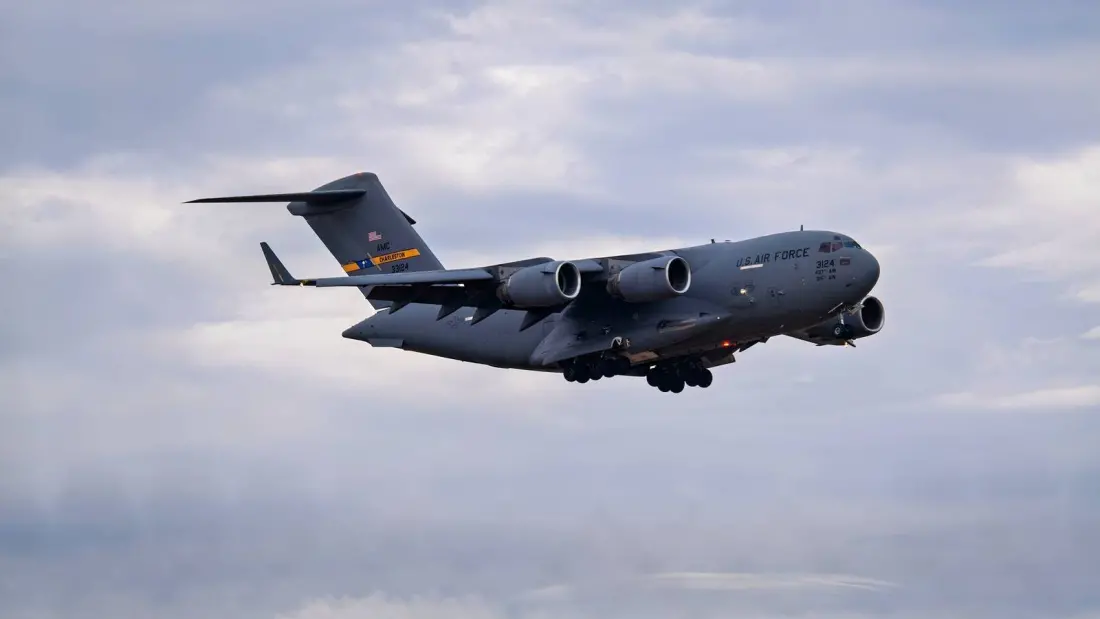
The C-17 Globemaster III is one of the biggest workhorses in military aviation, capable of hauling an M1 Abrams battle tank across continents — yet a standard flight needs a crew of only three: a pilot, a copilot and a loadmaster.
That lean setup is deliberate. The US Air Force designed the aircraft around military transport needs rather than airline-style service, so there are no cabin crew. The two pilots split flying, navigation and systems management across a 174-foot airframe with four turbofan engines, while the loadmaster handles everything in the cargo bay — weighing, positioning and securing loads so the aircraft stays balanced and safe. Fewer crew also means fewer people exposed to risk and lower operating costs on demanding deployments.
The C-17's party trick is where it can operate. Despite its size, it lands on runways as short as 3,500 feet and just 90 feet wide, and it can even reverse under its own power to turn around on a narrow strip. That opens up remote airfields most heavy transports can't touch. Inside, 18 pallet positions take up to 170,900 lbs of cargo, driven straight on through the rear ramp.
It moves people too: up to 102 troops or paratroopers in standard configuration, dropped through the rear cargo area or delivered to bases quickly. In aeromedical evacuation fits, it carries up to 36 stretcher patients plus 54 ambulatory patients and attendants, with five medical staff — two flight nurses and three technicians — added to the core crew.
The most striking example of its capacity came in August 2021, when a C-17 with the callsign Reach 871 evacuated 823 people from Kabul, Afghanistan, in a single flight — far beyond its normal seating, but a demonstration of what the airframe can do in an emergency.
Beyond the US Air Force, the type flies with the Royal Canadian Air Force, the Royal Australian Air Force, the Indian Air Force and the UK's Royal Air Force, making it one of the most widely shared heavy airlifters in the world.
For anyone fascinated by aviation, the C-17 is a reminder that raw size doesn't demand a big crew — it demands clever design and well-defined roles. Spotting one at an airshow or a public open house is a highlight, since operators including the RAF and USAF regularly display the type, and its short-field performance and thrust-reversing landings are genuinely unusual to watch.
Story credit: Simple Flying