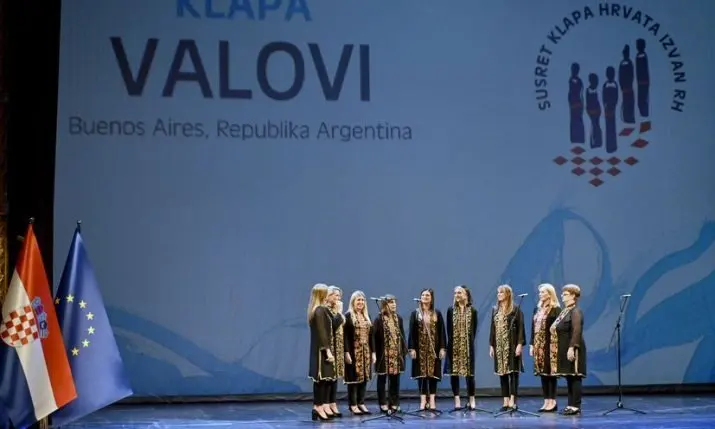
An eight-voice women's choir in Buenos Aires has just marked a quarter-century of singing Croatian music thousands of kilometres from the Adriatic. Klapa Valovi celebrated its 25th anniversary with a concert at Teatro Empire, drawing members of Argentina's Croatian community along with visitors from Zagreb, including Croatian Heritage Foundation director Zdeslav Milas and MEP Davor Ivo Stier. The foundation used the occasion to hand the group an award for preserving Croatian cultural heritage abroad.
The story began casually in 2001, when co-founder Daria Trošelj and a few friends were asked to sing songs from their youth at an anniversary event. They shifted from pop to klapa — the a cappella tradition from Croatia's Dalmatian coast — and never looked back. All eight singers are second- or third-generation descendants of Croatian emigrants: Jelena Nadinić, Cecilia Fernandez Šarić, Ivana and Veronica Šimunić, Clara Borhi, Valeria Fernandez Šarić, Silvia Detelić and Trošelj.
Early on, they struggled to find Croatian songs arranged for women's voices, so they built their own repertoire over time. It now blends traditional and contemporary klapa numbers — titles like Zemlja, Cetina and Umiri se more — with arrangements of Argentine and international music. The group has recorded three albums (2012, 2015 and 2024, one of them live), all streaming on Spotify.
Valovi's reach goes well beyond Buenos Aires. They have performed across Argentina, in Santiago de Chile, Montevideo, Asunción, New Orleans and Chicago, and back in Croatia itself. This year they sang at the fourth Gathering of Croatian Diaspora Klapa Groups in Split, then toured Dugopolje, Bol, Vitez, Posušje and Mostar. In September they also featured at Argentina's Immigrants' Day celebrations — exactly the kind of outside-community performance musical director Marko Frković values most for introducing Croatian culture to new audiences.
The next challenge is generational. The group rehearses weekly in Buenos Aires and hopes to recruit younger women to carry the tradition forward. For travellers, this is a reminder that Croatian culture isn't confined to the coast: Buenos Aires has one of the largest Croatian communities outside Europe, and its klapa scene is thriving. If your Argentina trip coincides with a community event or diaspora festival, hearing Dalmatian harmonies in a South American capital is a genuinely memorable detour — and the same klapa sound awaits in Split, Bol and the Dalmatian hinterland if the music inspires a Croatia trip of your own.