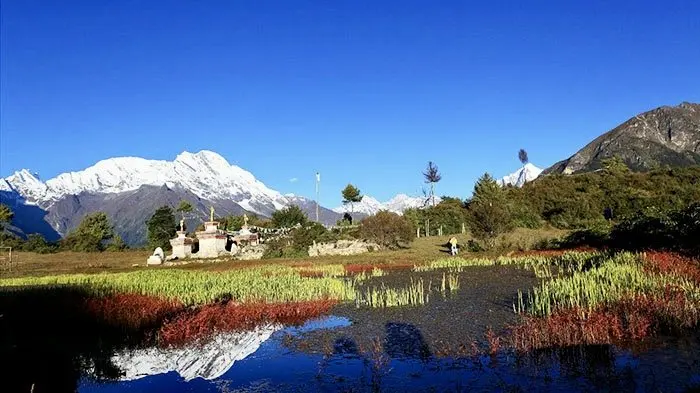
The Kyirong Valley on Tibet's southern edge was dealt a cruel joke of geography and language: the name translates as Valley of Happiness, yet in late August a glacial flood that began on Langtang Lirung swept through it, killing thousands. Behind those headlines lies one of the Himalaya's richest cross-border stories.
For centuries Kyirong was a corridor, not a checkpoint. Kings, traders, pilgrims and Buddhist teachers moved through the pass between Tibet and northern Nepal. The valley anchored a Tibetan kingdom from the 13th to 17th centuries and grew wealthy on Himalayan trade. It is tied to the revered Jowo Wati Zangpo statue of the Bodhisattva of Compassion, and the Indian master Atisha taught here while helping revive Buddhism in Tibet. Austrian cartographer Peter Aufschnaiter counted 26 monasteries and temples in the valley in the 1940s — many later destroyed during the Cultural Revolution.
That monastic count came courtesy of a remarkable episode. Heinrich Harrer and Aufschnaiter, interned by the British after their 1939 Nanga Parbat reconnaissance expedition, escaped in 1944 and trekked into western Tibet, reaching Kyirong in January 1945. Despite orders to move on to Nepal, they stayed roughly ten months. Harrer devoted a chapter of Seven Years in Tibet to the valley, calling it the Village of Happiness and writing that if he could choose where to grow old, it would be Kyirong.
The mountains above tell their own story. Langtang Lirung lifts about 5,500 metres above the Trisuli River in just 16km, with hanging glaciers perched over both the Langtang Valley and the Kyirong-Rasuwa trench. H.W. Tilman surveyed it in 1949; the peak was first climbed in October 1978 by Seishi Wada and Pemba Tsering Sherpa, with a Polish team taking the first winter ascent in 1988. It has always been lethal — after 2010 no one summited for 14 years, until Marek Holecek and Ondrej Huserka opened the East Face in October 2024. Huserka died in a crevasse fall during the descent.
The valley has also absorbed repeated disaster. The 2015 Gorkha earthquake buried Langtang village, killing 240 to 300 people there alone. When the Zhangmu crossing then closed, Kyirong became the main entry for international teams heading to Shisha Pangma, and by the 2010s it had turned into a major border post — a fate its longtime residents never imagined. Families on both sides share bloodlines: many Langtang households in Nepal trace their roots to Kyirong, while descendants of Gorkha soldiers lived on the Tibetan side for generations before receiving Chinese citizenship only in 2003.
For travellers, Kyirong matters as the gateway most trekkers and climbers now use between Nepal and Tibet, and as a reminder that the borderlands of the Himalaya were one connected world long before hard borders. The flood has made access uncertain, so anyone planning to cross should check current conditions closely. — ExplorersWeb