It started with a handful of school matches on a Melbourne park in winter 1858, when teams from Scotch College and Church of England Grammar School — the school that would become Melbourne Grammar — agreed to play each other at football. Those games are widely regarded as the first organised fixtures of what is now Australian rules football, a sport that would grow into the country's biggest winter spectacle.
Where exactly the game came from is still debated. Aboriginal ball games like marngrook and Irish Gaelic football have been floated as possible influences, but the stronger evidence points to the English public school tradition — Eton, Winchester and their rivals each played their own version of football, so every match began with a negotiation over whose rules applied. Colonial Melbourne copied the habit: long pre-match haggling over the rules was part of the ritual.
Things were formalised in May 1859, when champion cricketer Tom Wills and others at the Melbourne Cricket Club wrote down a proper rulebook. Some of the original rules sound odd today: a free kick for catching a ball cleanly from a kick (the origin of the mark), goals that had to be kicked not carried, throwing banned entirely — and tripping and pushing explicitly allowed. Over the following decade, tripping was outlawed and players gained the right to run with the ball, as long as they bounced or grounded it every five or six yards.
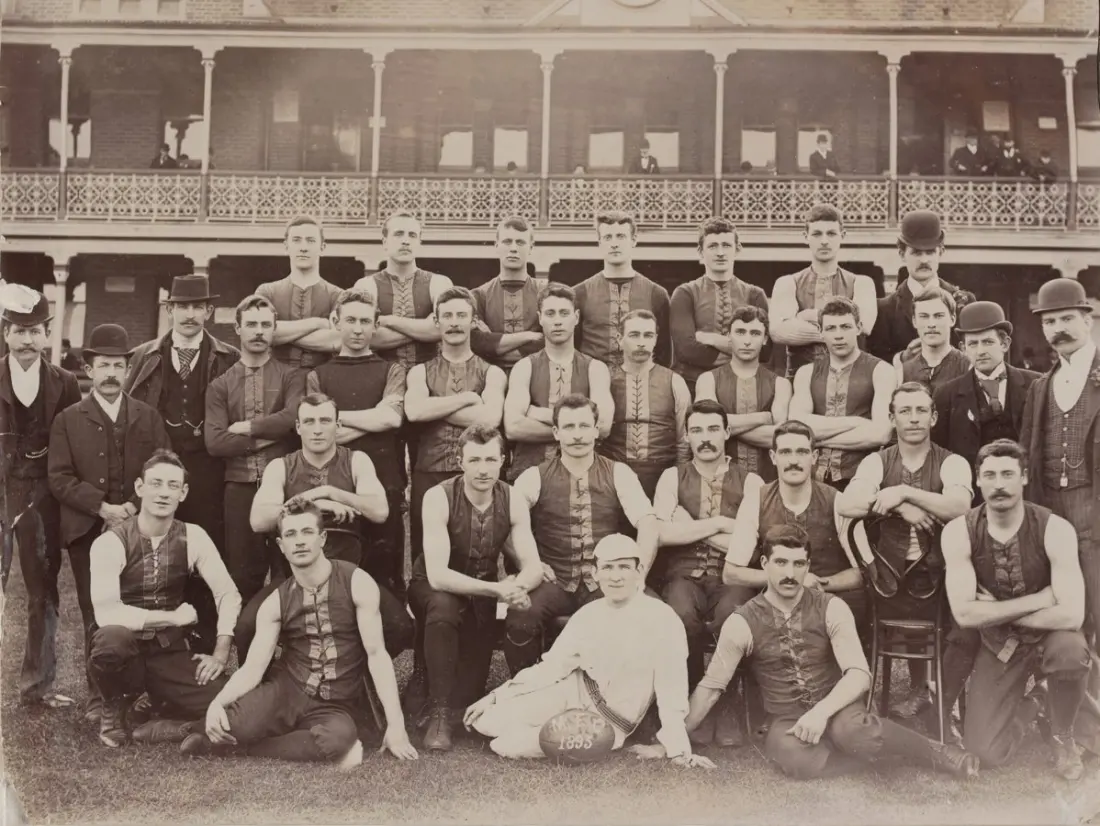
By the 1870s the game had taken over Melbourne. Clubs sprang from suburbs, hotels, churches and workplaces, senior matches settled into a 3pm Saturday slot so manual labourers could play, and free games on open parkland drew crowds of up to 3,000. Cricket clubs wanted none of it — they feared (correctly, as two 1869 matches on the MCG proved) that footy fans would wreck their turf. But when Carlton fenced and levelled a new ground in 1876 and charged admission, 5,000 people paid up. The business case was obvious, football moved onto cricket ovals across the city and country towns, and by decade's end 10,000-strong crowds were regular at the MCG.
Money reshaped the sport. The Victorian Football Association formed in 1877 to run the game, but arguments over splitting gate takings between strong and weak clubs festered. In 1896 the eight powerhouses — Melbourne, Essendon, Geelong, Collingwood, South Melbourne, Fitzroy, Carlton and St Kilda — broke away to form the VFL. The league expanded through the 20th century, went national with the South Melbourne Swans' 1982 move to Sydney and the 1987 additions of Brisbane and West Coast, and renamed itself the AFL in 1990. Today it's an 18-team national competition stretching from Perth to Greater Western Sydney.
For travellers, this history is written into Melbourne itself. The MCG, where footy was famously banished from and then triumphantly returned, still hosts the game's biggest moments, and a winter AFL match there is one of Australia's great live-sport experiences. Footy-obsessed suburbs like Carlton, Collingwood and Richmond each carry a club and a pub culture of their own, and the National Museum of Australia in Canberra preserves this story as part of its Defining Moments project. If you're in Melbourne between March and September, catching a game — any game — is the best way to see the sport's parkland origins still alive.