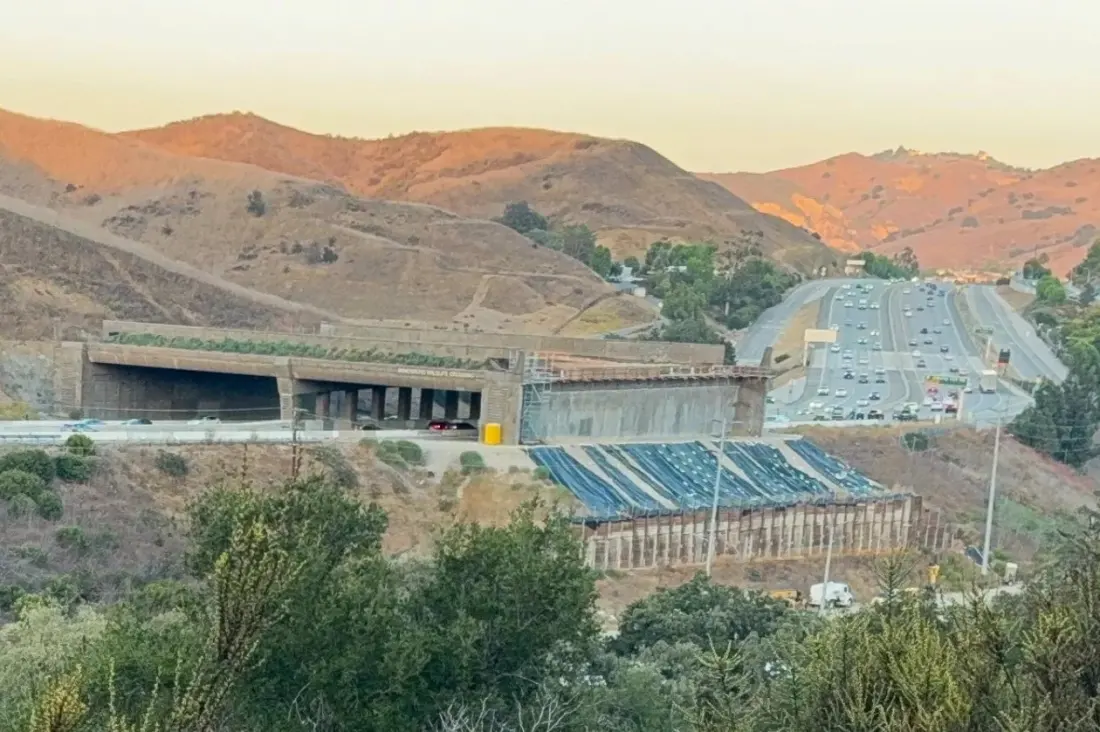
A bridge you'll never drive on is about to become one of California's most talked-about pieces of road infrastructure. The Wallis Annenberg Wildlife Crossing, spanning all ten lanes of the 101 Freeway at Liberty Canyon near Agoura Hills, opens to wildlife on 2 December 2026.
The idea is simple in principle: reconnect the Santa Monica Mountains with the Simi Hills to the north, so animals can move between the two without dodging traffic. A second span crosses Agoura Road, and the whole setup includes fencing to funnel animals toward the crossing, plus barriers designed to muffle traffic noise and block the glare of headlights. The deck itself is planted with native vegetation, so from a distance it should read as landscape rather than engineering.
The project became famous partly thanks to one cat. P-22, the mountain lion that lived in Griffith Park for over a decade before his death in 2022, is thought to have crossed both the 101 and the 405 to get there — and he ended up with the smallest home range ever recorded for an adult male mountain lion. His story put a face on the problem: freeways trap wildlife populations in place, cutting off territory and mating options and pushing isolated groups toward inbreeding. For mountain lions around LA, that genetic squeeze is a real long-term threat, which is why this crossing matters beyond good optics.
Early signs are promising. A camera caught a coyote exploring the southern slope of the unfinished bridge in late October, and bobcats, grey foxes and mule deer already use a nearby trail — all species researchers will be monitoring once the crossing is live. Scientists plan to track which animals use it over the coming years and whether it genuinely restores genetic and habitat links between populations.
For travellers, this is worth knowing if you're road-tripping through the LA hills or heading up the coast on the 101. There's no viewing facility as such — the crossing is designed for animals, not tourists — but the stretch of freeway at Liberty Canyon now carries one of the boldest examples anywhere of cities rethinking how roads and wildlife share space. Pair a drive past it with time in the Santa Monica Mountains, where the wildlife it's meant to help actually lives. And for anyone interested in conservation travel, this is the largest project of its kind in the US and a blueprint likely to be copied elsewhere.
Most drivers will glide over it without noticing. For a young mountain lion looking for new hills and new mates, it could be the difference between a future and a dead end.