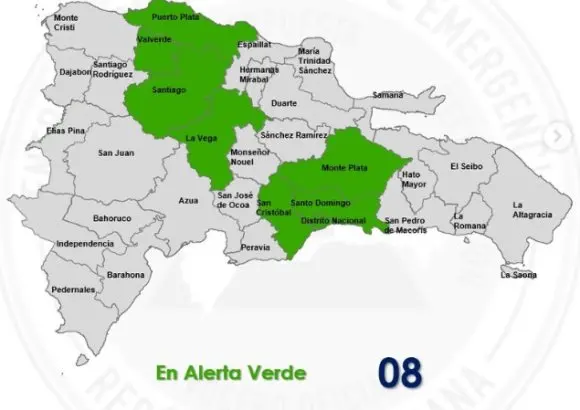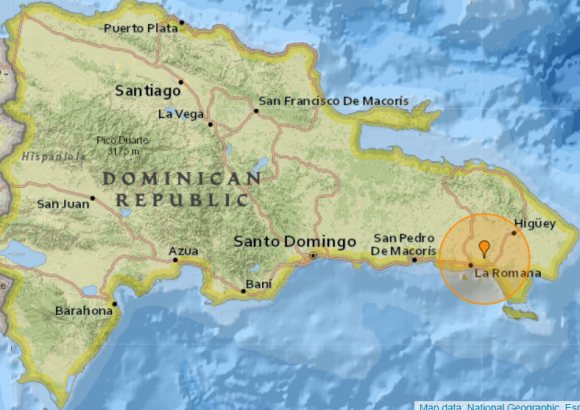
A string of light earthquakes was recorded across the Dominican Republic on Tuesday, with the strongest — a magnitude 3.9 — striking near La Romana, one of the country's most popular resort areas on the southeastern coast.
According to the U.S. Geological Survey, the La Romana quake hit at 11:55 a.m. local time, roughly nine kilometres northeast of the city. Crucially for anyone holidaying in the area, it occurred at a depth of 117 kilometres. Deep quakes like this one tend to be felt far less sharply at the surface, and at magnitude 3.9 it sits well below the level that causes damage.
The Dominican Republic's own National Seismology Center, run by the Autonomous University of Santo Domingo (UASD), logged several other small events the same day across the country and nearby waters. These included a magnitude 3.0 tremor south of Punta Cana, a magnitude 3.2 northeast of Miches, and a magnitude 2.6 northwest of Sabana de la Mar — all in or around the eastern region where most international visitors stay.
There were no reports of damage or injuries, which fits the pattern. The island sits in a seismically active zone between the North American and Caribbean tectonic plates, so minor tremors are recorded regularly, often without residents or tourists even noticing. Events in the 2.5 to 4 range are routine and rarely make any impression on a beach day in Punta Cana or a round of golf in La Romana.
For travellers, the takeaway is context, not alarm. If you're booked into the all-inclusive resorts of Punta Cana, the cruise port of La Romana or the eco-lodges near Miches and Sabana de la Mar, this kind of seismic activity is a normal feature of Caribbean geography rather than a warning sign. The practical move is the same as for any destination in the region: glance at the evacuation map in your hotel, note the assembly point, and otherwise carry on with the itinerary.
It's also worth knowing where to check if you ever feel a shake while in the country. The UASD's seismology center publishes a running catalogue of local events in Spanish, and the USGS offers near-real-time global data in English. Both are far more reliable than hotel lobby chatter or viral social media clips.
In short: a quiet, deep quake near La Romana and a handful of even smaller ones nearby — the seismic equivalent of a cloudy afternoon. Nobody's holiday plans need to change.