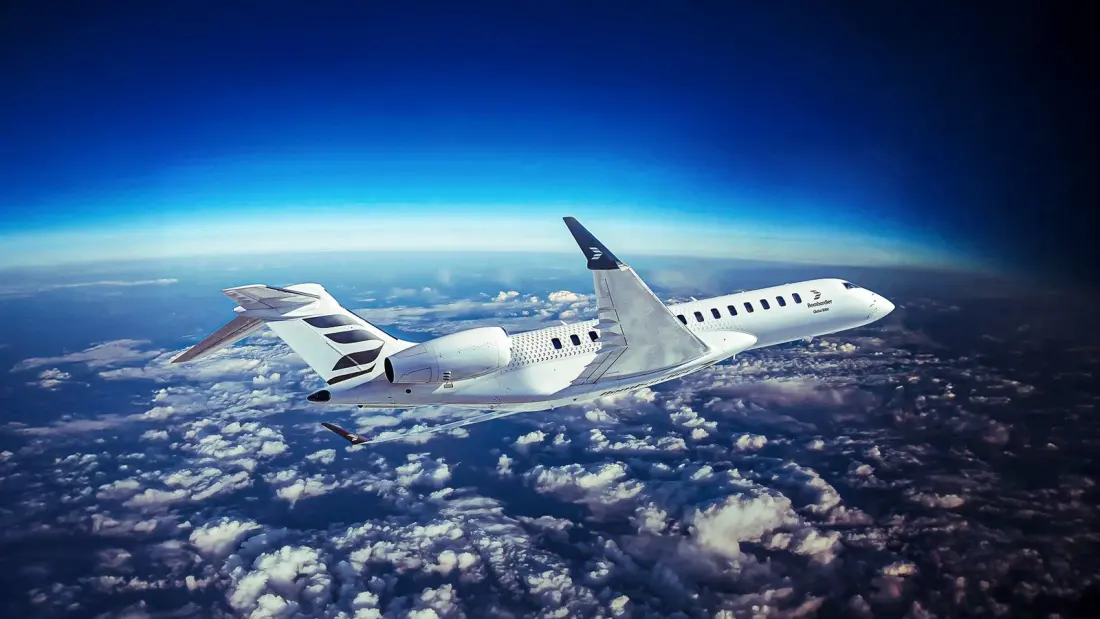
A runway a few hundred metres from Canary Wharf can now, in principle, send a large business jet nonstop to Los Angeles. On September 10, the UK Civil Aviation Authority approved Bombardier's Global 8000 to fly London City Airport's notoriously steep 5.5-degree glide slope — nearly double the descent angle used at almost every other airport on Earth.
London City has always been a filter. Any approach steeper than 4.5 degrees counts as a steep approach under CAA rules, and LCY is the only UK airport that imposes one. The angle used to be even harsher: before a 1992 runway extension it sat at 7.5 degrees on a strip of just 1,080 metres, limiting traffic to stubborn aircraft like the Dash 7. Since April 2019 it has been 5.5 degrees, with landing distance increased to 1,199 metres — changes framed partly as noise measures, since a steeper path keeps aircraft higher over the docklands for longer.
Very few large jets have ever managed it. British Airways once ran a specially modified A318 on an all-business-class route to New York, but it needed a fuel stop in Shannon westbound and was a one-off. What makes the Global 8000 different is that the steep-approach capability is built into the standard production configuration. Bombardier's engineering chief Stephen McCullough credits leading-edge slats — which keep the wing generating lift at low speeds — plus braking systems able to absorb the extra energy of a faster, steeper descent. And the jet gives up nothing elsewhere: it cruises at Mach 0.95 with a range of 8,000 nautical miles, ahead of the 7500 it replaces, with Bombardier pitching nonstop routes from LCY to Los Angeles, Singapore, or Hong Kong.
The approval isn't a blanket pass. Each individual aircraft still needs its steep-approach supplement signed off by its own registration authority, and London City runs its own operator approval on top. For now the airport's steep-approach business jet list is short: Global 7500s from three operators, plus Gulfstream's G650 and G650ER. NetJets, the Global 8000's launch customer, plans to migrate its whole 7500 fleet to the new type — a move that only adds up if London City access matters that much. Bombardier reckons flying into LCY instead of Farnborough or Luton saves 60 to 90 minutes of ground transfer into central London, which for private jet clients is most of the point.
The concept was proven back in May 2019, when a Global 7500 flew the longest flight ever out of London City — a demonstration run to Los Angeles Van Nuys. The 8000 turns that party trick into a production capability. And the steep-approach club extends beyond London: Aspen, Lugano and a handful of other airports demand similar discipline, so an airframe that treats a 5.5-degree approach as routine opens doors well beyond the Thames.
For travellers, this is a story about time rather than glamour: the difference between a transfer across London's traffic and landing ten minutes from the financial district before heading straight across an ocean. Watch how fast other regulators approve the supplement and how quickly NetJets completes its fleet swap — that will tell you when this becomes a genuinely bookable option rather than a certification headline.
Story via Simple Flying.