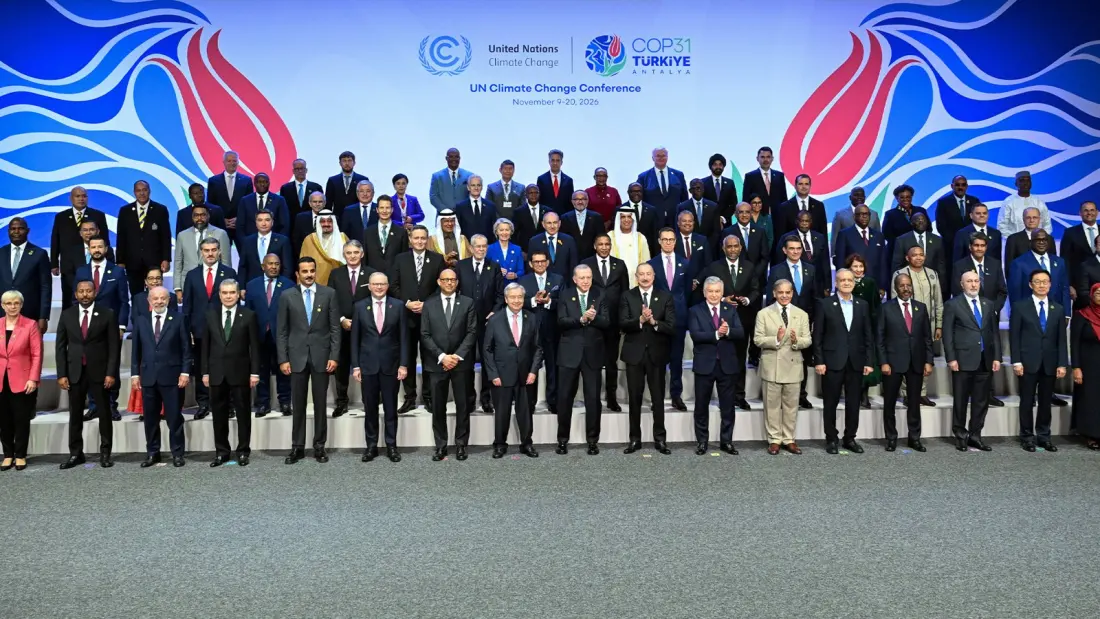
Kazakhstan isn't a country most travellers associate with green energy, but that's shifting fast. At the COP31 climate summit in Antalya, the government signed roughly $1.2 billion in agreements covering new wind farms and a nationwide smart-meter rollout — part of a broader push that reaches well beyond the energy ministry.
The headline deals include a 150-megawatt wind plant in the Turkistan Region and a much larger one-gigawatt project in the Kostanai Region, plus the Aqyl Energy scheme to install 1.35 million smart gas meters with remote data transmission. Prime Minister Olzhas Bektenov, attending on behalf of President Kassym-Jomart Tokayev, framed it as part of a wider programme: renewables have quadrupled their share of Kazakhstan's energy mix in six years to 8%, with a 15% target by 2030. Other plans span nuclear, solar, green hydrogen, and a Green Energy Corridor with Azerbaijan and Uzbekistan aimed at exporting clean electricity.
There's a reforestation story here too, and it's genuinely striking. Nearly 1.7 billion trees have been planted in the past five years, with 270 million more seedlings planned for 2027 — working toward a two-billion-tree goal. The Taza Qazaqstan cleanup initiative has pulled in over six million participants. Kazakhstan also used its national pavilion to spotlight the restoration of the Northern Aral Sea, Caspian ecosystem protection, and satellite-based climate monitoring.
One project worth watching for future trips: Alatau City, a planned low-carbon urban development. And on the financing side, Kazakhstan launched its Just Energy Transition Investment Platform (QaJET) at the summit, with the EBRD offering up to $100 million in concessional financing and grants, plus up to $1 billion in potential direct financing.
Why should a traveller care? Because the places this affects are real destinations. The Turkistan Region is home to the mausoleum of Khoja Ahmed Yasawi, a UNESCO World Heritage site. The Aral Sea restoration effort is one of Central Asia's most dramatic environmental comebacks — the small but recovering North Aral is increasingly mentioned in adventure-travel itineraries. Caspian coast towns like Aktau already draw regional visitors. As wind farms, tree plantations and cleaner air reshape the landscape, the experience of travelling through the steppe changes with it.
For anyone planning a trip, the practical takeaway is simple: Kazakhstan remains a vast, under-visited country with visa-free access for many nationalities, improving infrastructure, and a government actively courting international investment and attention. The green push doesn't just make headlines at climate summits — over time it means more reliable power in remote regions, better-managed natural areas, and new points of interest beyond Almaty and Astana. If you've been putting off the steppe, the next few years might be a good window: you'll see the transformation beginning rather than finished.