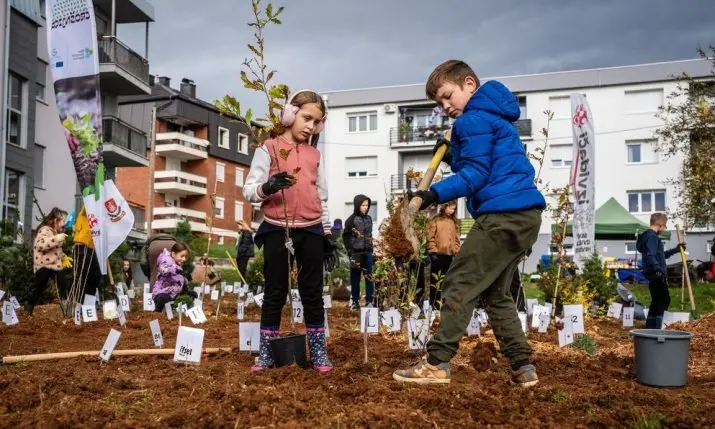
Slunj, a small town in Croatia's karst heartland best known for its watermills and the Rastoke village nearby, has a new attraction that's barely taller than a shrub — for now. This week, 140 volunteers planted a 'Crošnjica', a miniature urban forest covering roughly 250 square metres on municipal land beside Slunj Primary School. It holds 342 plants across 32 species: 20 types of trees and 12 shrubs.
The planting technique is the interesting part. Crošnjica woodlands use the Japanese Miyawaki method, where multiple layers of native vegetation — trees, shrubs and ground cover — go into densely prepared soil all at once. The result grows unusually fast, supports high biodiversity, and once established largely looks after itself. The mix of species also makes the young ecosystem more resilient than a conventional single-species planting.
The Slunj event was organised by the Scout Association of Croatia with the town, the primary school and the local Red Cross, co-funded through the EIT Community New European Bauhaus programme. It's the fourth Crošnjica in Croatia, and ten more are already agreed. The scout association and creative agency HEARTH, who run the project, have form here — they're also behind Boranka, CO2mpensating by Planting and Šumoborci.
What made the Slunj planting stand out was who turned up. Schoolchildren did most of the digging — one fifth-grader, Mia, planted four plants including two rosemary — while 70-year-old Zdravka, who lives across from the site, put in three oaks, two pines and a willow. Workshops pairing young and old covered biodiversity and nature protection, and the finished woodland will double as an outdoor classroom. Mulch, gravel paths, benches and bins are being added in the coming days.
Why should a traveller care? Two reasons. First, Slunj itself is an underrated stop between Zagreb and Plitvice Lakes, and Rastoke — a tiny village where the Slunjčica River fans over watermills and cascades — is the town's real draw. Second, Crošnjica forests are designed to be visited and watched over time, so if you pass through in a few years, that bare patch by the school should be a surprisingly dense patch of self-sustaining woodland. Small-scale, community-led projects like this are becoming a quiet feature of Croatian towns, and they're free to wander into.
If you're plotting a route through inland Croatia, Slunj slots neatly into a Zagreb–Rastoke–Plitvice itinerary. Come in late spring for green valleys and full river flow, or in autumn for colour and thinner crowds.