London Fashion Week just had its biggest season in years: 47 shows across five days, a buzz of new energy, and a clear sense that British fashion is pushing back after a bruising few years post-Brexit. The theme running through the week was a look backwards — to Old Master paintings, heritage fabrics and house archives — as designers tried to move the industry forward.
The headline act was Burberry, which celebrated its 170th anniversary with a collaboration with Celia Birtwell, Britain's most famous fabric designer, staged at the Chelsea College of Arts. Creative director Daniel Lee reworked the brand's signature checks and bold jacquard trenches, finishing with mimosa-flower covered trench coats. The optimism is backed by numbers: Burberry just posted its best quarter in three years, with turnover up 5 percent to £455m as CEO Joshua Schulman refocuses the house on the trench and the check. A new exhibition, The Burberry Trench: Crafting an Icon, opened at the V&A the night before the show.
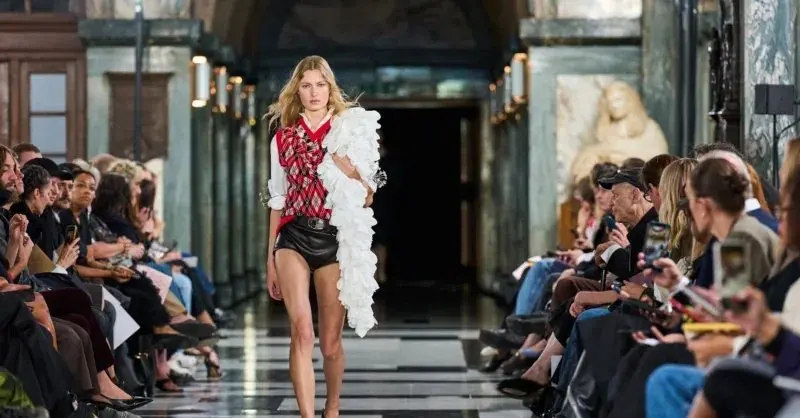
McQueen made a dramatic return to the London schedule after 25 years in Paris, showing beneath the Gothic arches of Lincoln's Inn. Creative director Seán McGirr — inspired by Piero della Francesca's The Baptism of Christ — sent out models in two-foot silver wax horns, leather harnesses and sharp Savile Row-informed tailoring made with Huntsman. Front row: Emma Corrin, Emilia Clarke and Florence Welch.
Simone Rocha, the week's most commercially successful designer with over 200 international boutique clients, took over the Old Bailey with a collection inspired by Caravaggio's The Taking of Christ — cocoon dresses, sequinned minis and sapphire velvet gowns in what she called 'Caravaggio blue'. Erdem swapped his usual Bloomsbury muse for Barbette, the trapeze artist adored by Jean Cocteau, staging glittering leotards and ringmaster tailcoats at Camden's Roundhouse. Mulberry's much-hyped debut under Christopher Kane refreshed the iconic Bayswater bag across sleek, retro-utilitarian looks, while Di Petsa delivered the week's most theatrical moment: a pregnant Leigh-Anne Pinnock leading six sirens in sheer chiffon.
Fresh talent shone too. Paolo Carzana staged medieval-fantasy pieces in a calboxed church; Aaron Esch took over Camden's Electric Ballroom; Estonian designer Johanna Parv showed high-impact activewear; and French-born Pauline Dujancourt, now backed by Paul Smith's foundation, looked ready for a Paris couture gig.
For travellers, the takeaway is that London remains fashion's best training ground and one of its most watchable weeks. The shows also map neatly onto a great city trip: the V&A's trench exhibition is open to the public, and the venues — Lincoln's Inn, the Old Bailey, the Roundhouse, St Martin-in-the-Fields — are reasons in themselves to explore the capital. For industry watchers, the mood shift at Burberry and McQueen suggests the 'Battle of Britain' for fashion's fortunes may just be turning.
Original story: Elite Traveler.