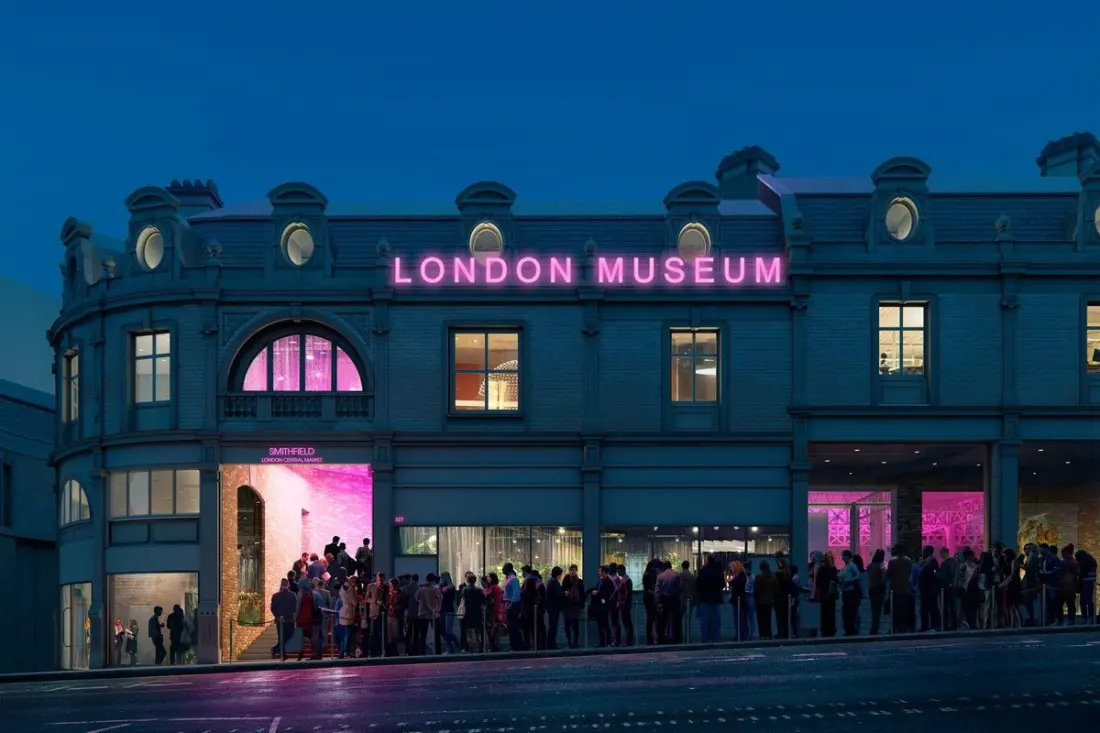
After four years without a city museum and a decade of work, London Museum opens its doors on 28 November in a £437m transformation of two former market buildings near Farringdon station. It's a rename (it was the Museum of London), a move from its hard-to-find London Wall site, and a fresh start timed to its 50th anniversary, with seven million objects under one roof.
The new home is the derelict Smithfield Victorian General Market, once the country's biggest meat and poultry trading site. Architects have restored Horace Jones's facades, preserved decorative ironwork, and turned the vast trading floors into galleries. During works in 2019, builders broke through a wall and discovered 800 square metres of lost Victorian underground vaults and salt stores, which will host rotating displays and events. A neighbouring 1960s poultry market joins in 2028 as a learning centre and space for temporary exhibitions.
The permanent galleries split into three parts. Real Time is the entrance, with giant animated screens streaming live city data such as the day's bus count. Our Time, upstairs, focuses on living memory and doubles as a social hub with a cafe and events space; its first programme, "London Tastes", guest-edited by Ruby Tandoh and Jonathan Nunn, celebrates the capital's food culture, from Brixton Market and Beigel Bake to pie and mash shops. Expect the original red sign from the first Morley's chicken shop in Sydenham too. Down at Roman street level, Past Time traces London from its earliest inhabitants through the Great Fire and the Blitz to the 2012 Olympics.
The vaults' first exhibition, "Londinium: the making of a Roman city", is free but opens in spring 2027, with never-before-seen Roman artefacts from the Bloomberg Collection: wax writing tablets, an infant's feeding bottle, and Britain's earliest known Eurasian cockroach eggs, found in a Roman bakery oven. In the meantime, look out for the window in the old salt store where you can watch Farringdon trains rumble past while passengers peer in.
Director Sharon Ament wants the museum to be a place people simply hang out in, with later hours for commuters, free entry to core exhibitions, and content spanning fashion, music, food, empire and poverty. For visitors, the practical win is location: you step off a train at Farringdon and you're basically there, a big change from the old tucked-away site. Even with Londinium on hold until 2027, the permanent galleries alone make it an easy, free addition to a London itinerary, especially paired with the historic market streets and the revived Smithfield quarter around it.