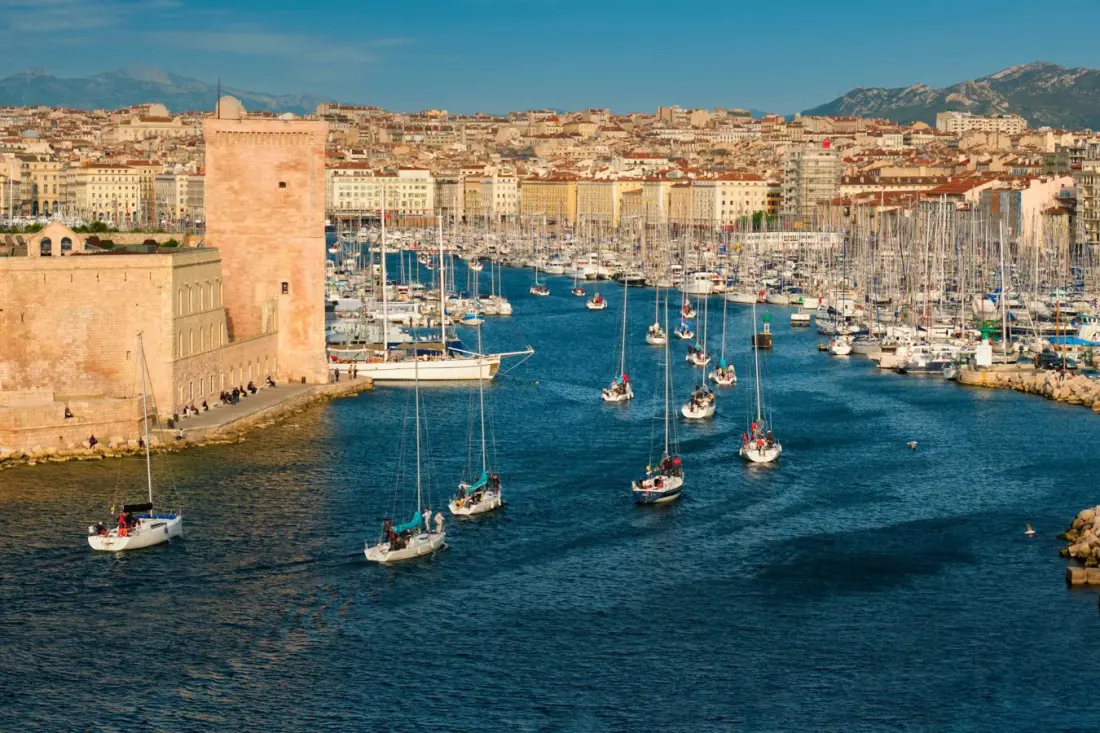
France's oldest city is quietly becoming one of Europe's most appealing summer escapes. Marseille has long been a port and a bit rough around the edges; now it's drawing young chefs, designers and small-business owners from across the continent, and the eating and drinking scene has caught up fast. Add Mediterranean sunshine and a national park on the doorstep, and you have a city break that doesn't feel like one.
Start at the Old Port, where fishermen still sell their catch each morning and ferries push off to the Frioul islands — a 30-minute public crossing gets you to Île Ratonneau for wild swimming and empty walking trails. Behind the port sits Le Panier, the city's oldest quarter, all narrow lanes, indie boutiques and art shops. Close by, the Mucem museum, with its lace-like concrete facade, covers centuries of Mediterranean history in one striking building.
Uphill, Cours Julien is the vintage-hunting and natural-wine quarter: try Merguez Fripe for colourful second-hand tees, then settle at Livingston or Limmat (hidden up a graffiti-covered staircase) for small plates and low-intervention pours. End the day at the Basilique de Notre Dame de la Garde, the 19th-century church topped by a gilded Virgin that crowns the city's highest hill, 154 metres above the port — Marseille's best sunset spot.
What sets Marseille apart is how quickly you reach water. Plage des Catalans is a short walk from the centre, packed at lunchtime with swimmers and volleyball games. For a slower afternoon, bus north to L'Estaque, a former fishing village once painted by Cézanne, with a working harbour and quiet coves like Plage de la Batterie. The big draw, though, is the Calanques National Park: 20 kilometres of white limestone peaks, pine forest and vivid blue coves stretching to Cassis. Short on time? Start at the fishing village of Les Goudes and walk the coast road to Calanque de Callelongue — sturdy shoes, plenty of water and real respect for the sun required.
Then there's the food. Bouillabaisse is essentially compulsory: the saffron, fennel and orange-zest fish stew comes with garlicky croutons and rouille, a garlic-chilli mayo you stir into the broth — book Chez Michel near Catalan beach for the classic version, or grab the stew-as-sandwich at Pain à l'Ail. The newer scene leans on migrant flavours: Congolese fine dining at AM, Tunisian chickpea soup at Chez Yassine in Noailles. And no visit is complete without pastis, cut one-to-four with water over ice — Le Café de L'Abbaye in Endoume is a fine perch as the light goes.
Sleep centrally at the 45-room Oceania Marseille, or wake to sea views at every window at Les Bords de Mer, which has a small spa and hammam. For a souvenir, Savon de Marseille soap has been made here for over 600 years — the Fer à Cheval factory runs free tours.
Getting there is easy: BA, Ryanair and EasyJet fly direct from the UK in about two hours, or take the Eurostar to Paris and a three-hour TGV from Gare de Lyon.
Why it matters: if you want a European summer city break where you can hike, swim, eat exceptionally well and still squeeze in a museum, Marseille now does it better than most.
Via Suitcase Magazine