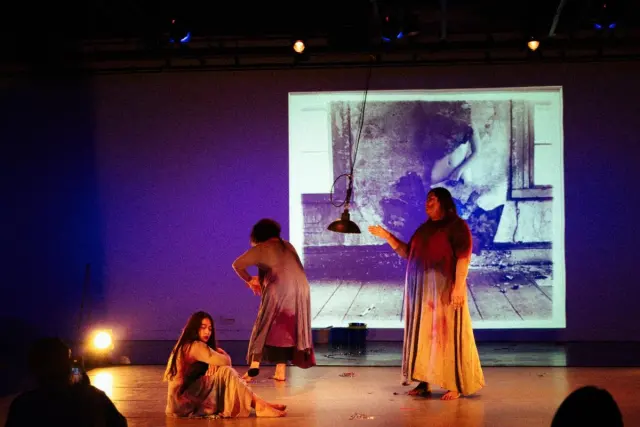
Bangkok Kunsthalle is currently hosting 'Memories', a group exhibition that asks what happens when stories cross borders, languages and generations. Curated by Thophon Sirias and staged under the venue's experimental 'Open Ground' platform for emerging artists, it brings together four research-driven practitioners whose works circle around movement — of people, of ritual, of political memory.
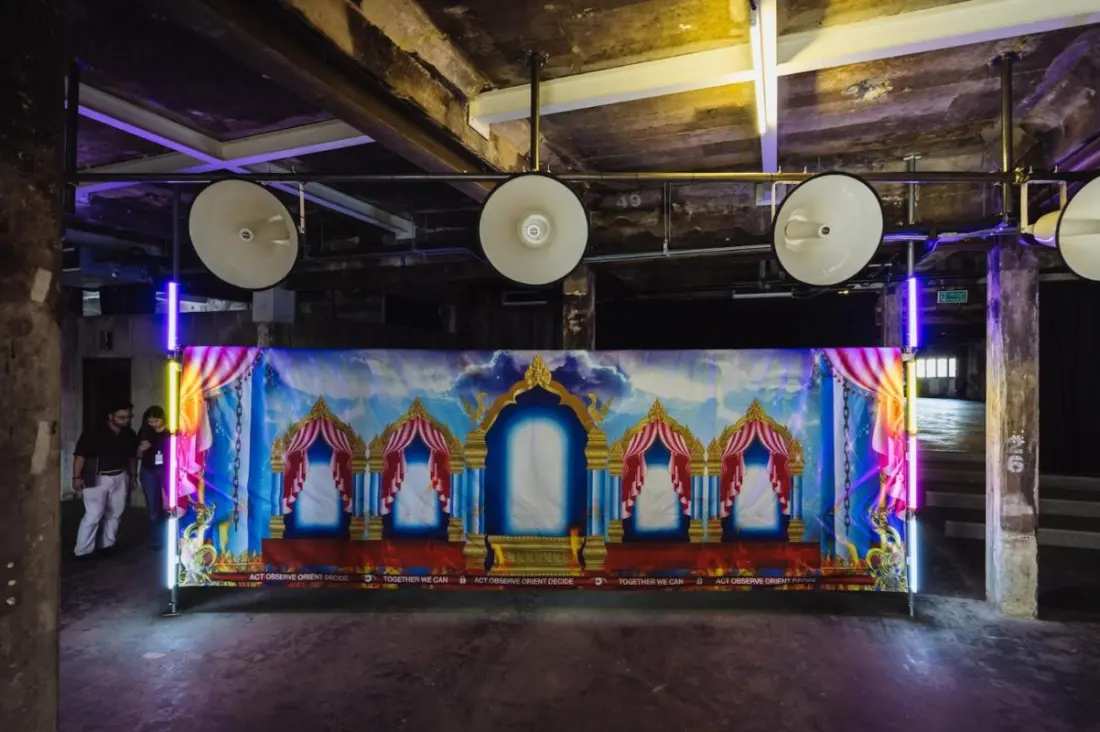
The most politically charged piece is by Tanat, a multidisciplinary artist, DJ and graphic designer whose Capital Complex combines digital printed canvases, an audio collage and a 35–60 minute sound loop. It addresses the 2010 Thai military crackdown on the Red Shirt protesters, which is subject to a 20-year statute of limitations set to expire in 2030. Google Maps images display the dates and locations of key clashes — Dinso Road near the Democracy Monument (10 May 2010), Rama 4/Bon Kai (16 May 2010) and Ratchaprarop Road/Lumpini Park (19–20 May 2010) — while a large canvas shows a traditional khon mask backdrop, layered with lo-fi music, marching rhythms and ambient recordings from historic sites. Tanat intends the sound itself to stir emotion and awaken memories in the audience.
Chinese-Australian saxophonist Kay Zhang, raised in Melbourne and now based in Zurich, contributes Piao/Loi Krathang. Her installation pairs printed canvases with an audio loop, weaving ritual sounds she argues are distinctively Asian into an atmosphere informed by her relocation and her travels through China, Taiwan and Thailand. She felt rituals were the best way to reconnect with her roots.
Thai-German artist Vannesa Bosch presents My Temple Is A Monstrous Body, a 12-minute video with six hand-blown glass sculptures on steel wires and chains. Her interest in spirituality versus scientific energy was sparked by glass sculptures lit by bulbs, and the film explores natural phenomenology through a narrated female voice.
Arisa Purkpong, a Thai-German visual artist and filmmaker based in Oslo, shows Untitled, a 49-minute video of conversations with her father, who left Thailand for Germany as a young man with no money and eventually survived as a Thai restaurateur. The work reflects on class, labour and the decision so many Thai families make to seek opportunity abroad.
Curator Thophon, an Art Theory graduate of Silpakorn University, describes the show as a way to connect Thai artists with an international network — a small circle capable of future collaborations rather than a mass group. During the run he has also arranged exchanges with the collective Ngaphron and with iLaw, the NGO known for uncovering discrepancies in the 2024 Senate election, to help artists better grasp Thailand's ongoing political struggles. As an experimental project, Open Ground has meant fine-tuning on the fly — the open-plan layout caused noticeable sound overlap, and some visitors didn't grasp that the longer videos demanded full attention.
For travellers in Bangkok, this is a chance to see genuinely fresh contemporary Thai art away from the usual gallery circuit, in a space where history and personal memory collide. Admission is free, and the exhibition is showing at Bangkok Kunsthalle, 995 Phatchat Alley (Khlong San).