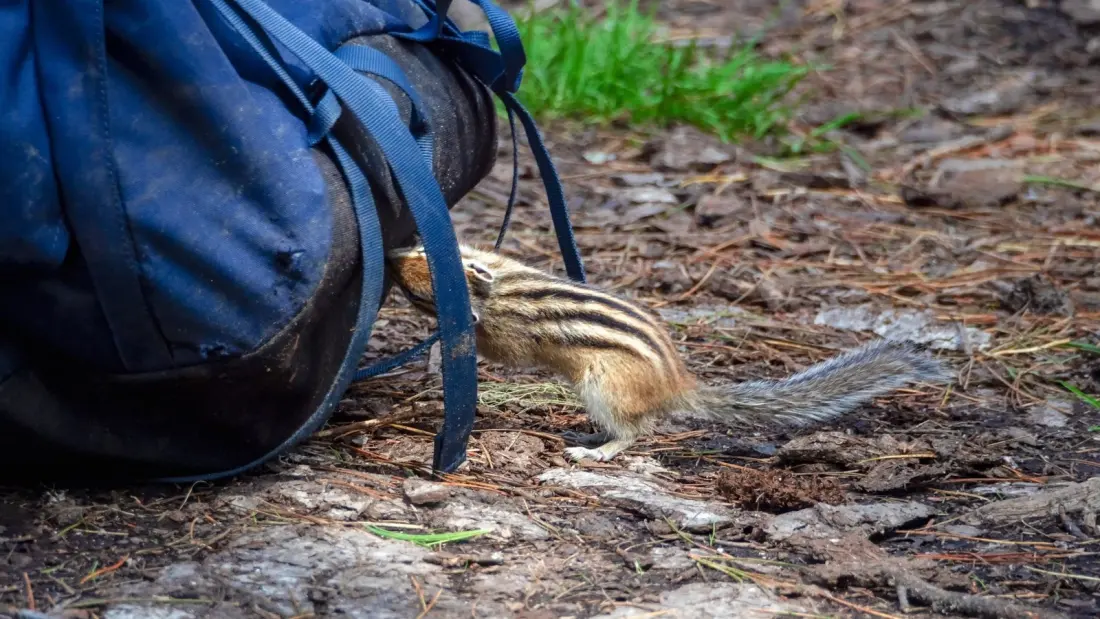
A mouse chewing through a backpack strap sounds like a horror story, but it's routine business in the backcountry. Rodents — chipmunks, squirrels, marmots, mice — are drawn to three things hikers carry: salt, food smells, and whatever you forgot to empty out of your pockets. The good news is that keeping them away costs almost nothing.
Start with the straps. Sweat leaves salty residue on pack shoulder straps, trekking pole straps, and hip belts, and rodents will happily gnaw them for the sodium. Rinsing straps in running water during the day and again at camp strips away the odour that attracts them. A few drops of hand sanitizer on trekking pole straps makes them less appetising, and a dryer sheet tucked into a salty pocket or around hammock straps works as a cheap deterrent. Stash poles upright in the ground overnight so the straps stay out of reach.
The classic bear hang doesn't actually stop mice — they'll run straight down the rope. The fix, popular in busy trail shelters, is what one guide calls the Mouse Swing: tie a barrier into the middle of your hang line. A clean tuna can or a quart yogurt container lid with a hole punched through it and knots on either side stops anything walking down the cord. Keep the bag a few feet off the ground so nothing can leap onto it.
Food discipline matters just as much. One hiker hung their pack from shelter rafters, only for a mouse to chew straight through the fabric to reach the remains of an energy bar in a pocket. Before bed, check every pocket for wrappers, gels, and even lip balm.
For food storage, a hard-sided bear canister is the gold standard but heavy. Lighter options include the Ursack Allmitey, a bag made from high-strength Spectra fibre that critters can't chew through, and the smaller Ursack Minor in Kevlar, which handles rodents but not bears. In the desert, stainless-steel mesh RatSacks have proved near-indestructible, and some US national parks, including Canyonlands, lend them out free. If odour control is the priority, LokSak OPSAK polyethylene bags are fully smell-proof — they won't survive teeth, but they stop animals investigating in the first place.
One last trick for genuinely bear-free areas: you can usually keep smelly items in your tent. It's not foolproof, but your sleeping bulk alone deters most mice.
This is useful far beyond backpacking. Anyone camping, staying in trekking huts, or leaving gear in rodent country — think hut-to-hut routes, desert parks, or busy long-distance trails — will recognise the problem. The kit involved is light and cheap, and the habits take minutes a day. Do yourself a favour: rinse the straps, empty the pockets, and rig a barrier on the hang line before some chipmunk makes a meal of your gear.